
 Pritha Bose

An email list can look healthy in your dashboard while quietly wasting campaign budget. Invalid mailboxes raise hard bounces, disposable addresses distort engagement, and stale contacts make open-rate comparisons less useful. For a business team, Email List Cleaning is a buying decision with operational consequences. You need a service that fits your upload volume, signup flow, email platform, and policy for uncertain catch-all results.
This decision gets harder once you compare details. Email list cleaning tools classify risky addresses differently, charge credits under different rules, and combine verification with deliverability or contact-data features. A low unit price can lose its advantage when duplicates, unknowns, or catch-all checks consume extra credits. A broad suite can waste budget when you only need to clean a quarterly CSV.
We reviewed 19 services and here we feature 15 tools in detail, some details last checked on August 4, 2026. Our comparison separates documented workflows from each tool vendor claims. I will show you what each service verifies, how your data moves, which current prices support a fair comparison, and where a pilot remains necessary. No verifier can promise engagement or inbox placement, so our recommendations focus on fit, billing clarity, and operational control.
What email list cleaning can and cannot verify?
Before comparing services, I want to separate what an email list cleaning service can verify from what your team must decide. A check usually begins with address format and syntax, then looks for a working domain and mail exchange records. Many services continue with an SMTP exchange or other mailbox-risk signals before labeling disposable, role-based, catch-all, abuse, or spam-trap risk. This email list cleaning tools comparison covers one-off cleaners, recurring email list scrubbing services, and broader email list hygiene services. Receiving servers still limit what a remote checker can know.
That boundary changes how you should use each result. A valid label does not confirm consent, recent engagement, or future inbox placement. A catch-all domain may accept every address during verification and reject an individual mailbox later. An unknown label can reflect a temporary server response rather than a bad address. We found email list cleaning and validation more useful when teams retain these categories instead of forcing every record into a keep-or-delete rule.
Your wider email marketing guide should therefore treat verification as one part of hygiene. Keep consent records, honor suppressions, review inactive subscribers, and monitor campaign bounces separately. Also, an important note – a list cleaner does not replace double opt-in or your email platform rules.
How we compared 19 tools and selected 15?
We checked what each tool documents, what it costs at a comparable tier, and what your team must still verify again. We applied our software evaluation methodology to current official pricing, documentation, integration paths, and independently Sprout24 discussion. For every material fact, we recorded access date, claim, source type, confidence. You can also read about Sprout24 to understand our research role.
We have Eleven list cleaning tools that has in-depth reviews. Verifalia, Mailfloss, Emailable, and AtData complete the featured 15 because they represent verification depth, recurring cleaning, deliverability support, and broader data hygiene. SendGrid Validation, ListClean, BriteVerify, and Proofy remain in a clearly labeled considered section.
Sprout Scores come only from our email verification tools review. Pricing is handled the same way: where we were not able to find the prices in current USD, you will see Unavailable or a direction to contact sales.
Quick comparison of 15 featured email list cleaning services:
| Service | Current Prive in USD | Free allowance | Bulk and real-time | Recurring auto-clean | Best fit for | Sprout Score |
|---|---|---|---|---|---|---|
| MailerCheck | $10/1,000 | 10 | Both | Via workflows | Small common-ESP teams | 8.9/10 |
| ZeroBounce | $129/10,000 | 100 monthly | Both | Integrations | Verification plus deliverability | 8.8/10 |
| NeverBounce | Unavailable | Unavailable | Both | Integrations | Established bulk/API flows | 8.8/10 |
| Hunter Email Verifier | Dynamic bundle | Free plan, quota unresolved | Dashboard bulk; single API | Workflow dependent | Finding plus verification | 8.4/10 |
| Kickbox | $5/500 on vendor G2 page | 100 | Both | Integrations | Native ESP connections | Unavailable |
| DeBounce | From $0.00045/check | 100 | Both | Integrations | Price-sensitive volume | 8.8/10 |
| Bouncer | $60/10,000 | 100 | Both | AutoClean | Transparent Pay-as-you Go and EU posture | 7.7/10 |
| Reoon Email Verifier | $11.90/10,000 | Up to 600/month | Both | Daily plans/workflows | Low-cost recurring checks | Unavailable |
| Xverify | Starts $0.01/check | Free assessment | Both | API dependent | Email plus contact checks | 9/10 |
| Clearout | Unavailable | 100 | Both | Automation integrations | GTM data workflows | 8.8/10 |
| MillionVerifier | Unavailable | Unavailable | Both | API dependent | Uncharged risky results | 8.8/10 |
| Verifalia | Unavailable | 25 daily | Both | Integration dependent | Configurable verification depth | 8.8/10 |
| Mailfloss | $29/$59/$209 monthly | 7-day trial | CSV; API on subscription | Yes | Daily ESP hygiene | 8.8/10 |
| Emailable | Unavailable | 250 reported | Both | Integrations | Verification plus deliverability | 9.1/10 |
| AtData | $0.008/check at 5,000 | 100 | Both | File/API/FTP | Email intelligence and hygiene | Unavailable |
You can shortlist by workflow, not score order. Mailfloss starts with a recurring ESP connection, while Bouncer and Reoon has one-off 10,000-address costs.
Verified 10k email contact cost versus documented workflow breadth
Read left to right for lower to higher verified cost and bottom to top for more documented workflow types. Upper-left points combine more documented workflows with lower verified cost.
| Service | 10k cost | Documented workflow count | Basis |
|---|---|---|---|
| Reoon | $11.90 | 3 | Published pack |
| Bouncer | $60 | 4 | Published pack |
| AtData | $80 | 3 | Qualified tier application |
| MailerCheck | $100 | 4 | Published unit rate |
| Kickbox | $100 | 3 | Vendor-supplied G2 rate |
| Xverify | $100 | 2 | Starting rate |
| ZeroBounce | $129 | 3 | Published pack |
Limitations: This is a feature-and-price map, not a ranking. Prices, taxes, add-on packs, and subscriptions change. Workflow breadth does not measure quality. AtData is qualified because its 5,000-credit unit rate must apply at 10,000.
Deep reviews: list-first verification tools
These reviews compare data flow, pricing, and limitations so you can narrow a pilot.
1. MailerCheck
MailerCheck fits small teams using MailerLite, Mailchimp, ActiveCampaign, or another supported platform. It accepts email list uploads and exposes a REST API, while Zapier and ESP connections handle data movement. Pay-as-you Go plan starts at $10 for 1,000 credits, the 10 free credits are a small sample, and purchased credits do not expire.
We found its entry point easy to understand, but there is no advertised volume discount. Sprout Score is 8.9/10. I would shortlist it when integration convenience matters more than securing the lowest large-list rate.

2. ZeroBounce
ZeroBounce combines bulk and real-time validation with deliverability tools. Current Pay-as-you Go tiers include $39 for 2,000, $69 for 5,000, and $129 for 10,000 credits. It provides 100 monthly free credits; Pay-as-you Go credits do not expire, and unknowns and duplicates are not charged.
One of our client user described acceptable backup use, while another user reported higher bounces after validation. Those were uncontrolled accounts with unknown list sources and campaign practices, so they support pilot testing rather than a quality conclusion. With 8.8/10 Sprout Score, ZeroBounce fits teams that will use its wider deliverability features instead of paying only for list scrubbing.


3. NeverBounce
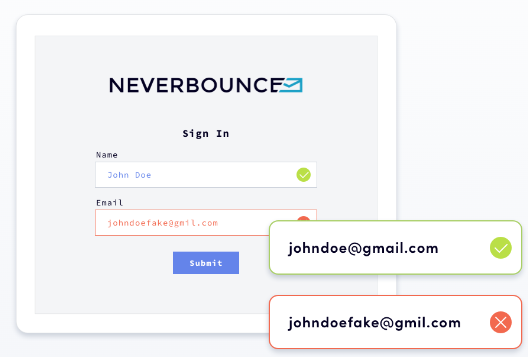
NeverBounce is easier to evaluate by workflow trial than price. It has CSV jobs, a bulk API, real-time checks, custom integrations, and CRM or ESP integrations.
Some of our team-mates praise their CSV or API integration, while others raise concerns around price, credit expiry, payment, and support. Its Sprout Score is 8.8/10.

| Service | Practical advantages | Material limitations |
|---|---|---|
| MailerCheck | Clear $10 entry; credits do not expire; common ESP and API paths | Only 10 free credits; no advertised volume discount |
| ZeroBounce | Bulk plus API; free monthly credits; unknowns and duplicates not charged | Higher low-volume minimum; catch-all decisions still need judgment |
| NeverBounce | Established bulk, real-time, and custom-integration workflows | Current pricing and credit rules not found clearly; mixed commercial-support reports |
4. Hunter Email Verifier
We found Hunter Email Verifier is most coherent when finding, leads, sequences, and verification share one account. Bulk verification runs through its dashboard, while the verifier API checks one address per call and costs $0.5 credit. Hunter documents API rate limits of 10 requests per second and 300 per minute. A buyer planning an email list clean API scrub should account for that single-record design.
Starter plan starts at $34 per month with 24,000 credits per year. Sprout Score is 8.4/10. Sometimes we got mailbox-verification uncertainty, but it is old conceptual context. Choose Hunter for combined prospecting..
5. Kickbox
Kickbox deserves attention when integrations drive your decision. Kickbox has 32 integrations, 100 free credits, and pricing from $5 for 500 checks. Because direct official pricing we were not able to find, treat that amount as vendor-supplied through external discussions and verify it at checkout for yourself.
We observe users praise setup and integrations to marketing platforms. Cost at higher volume and ambiguity in risky classifications recur as limitations. Kickbox belongs on a shortlist when native ESP movement is central, but the pilot should test how its risky output maps into your send, suppress, and review queues.


6. DeBounce
DeBounce has a starting rate of $0.00045 per check, provides 100 free credits, and purchased credits do not expire. Bulk upload, bulk API, real-time validation, and ESP or CRM connections cover a broad workflow.
Our Sprout Score is 8.8/10. We found an attractive advertised floor, yet a realistic quote must include the result and enrichment actions your team will use. DeBounce is a candidate for high-volume price control after you calculate those extra credits and confirm current pack totals.
7. Bouncer
Bouncer provides unusually clear Pay-as-you Go tiers: $8 for 1,000, $35 for 5,000, $60 for 10,000, and $400 for 100,000. New accounts receive 100 credits; purchased credits do not expire, and duplicates or unknowns are free.
Bouncer follows GDPR requirements, has SOC 2 controls, and stores data in the EU. 7.7/10 Sprout Score. I would shortlist Bouncer when billing transparency and an EU-oriented posture matter, while still treating catch-all resolution as probabilistic.
| Service | Practical advantages | Material limitations |
|---|---|---|
| Hunter | Combines finding and verification; documented API limits | Single-address API; low-tier verifier-only price unresolved |
| Kickbox | Broad integration claim; 100 free credits; bulk and real-time paths | Risky output needs policy work |
| DeBounce | Very low advertised floor; non-expiring credits; broad workflow | Exact packs unresolved; add-ons consume different credits |
| Bouncer | Transparent tiers; duplicates and unknowns free; AutoClean | Can cost more at scale; vendor security claims need independent review |
8. Reoon Email Verifier
Reoon Email Verifier has $11.90 for 10,000 credits and up to 600 free checks per month, plus 100 instant credits. Instant credits do not expire; daily credits reset. CSV, a bulk API up to 50,000 records per task, Quick and Power API modes, and Zapier, Make, n8n, WordPress, and Zoho integrations create useful range for a low-priced bulk email list cleaning tool.
Our team often use praise their CSV simplicity and API utility. Dashboard design and credit limits also appear in some of our discussions. I would test those daily-workflow limits before choosing it on price alone.
9. Xverify
Xverify begins at $0.01 per verification and offers a free assessment. It combines batch uploads and an API with email, phone, and address verification. Xverify states 98% accuracy and provides illustrative timing for 10,000-record consumer and B2B files, but those are vendor claims and actual processing can vary.
Its Sprout Score is 9/10. We would shortlist Xverify when contact-data checks beyond email are valuable; otherwise compare the cost against a specialist email list cleaner tool before buying extra scope.
10. Clearout.io
Clearout supports CSV or XLSX, bulk and real-time APIs, HubSpot, GoHighLevel, Google Sheets, WordPress, Zapier, Make, and webhooks. Its retention default is 30 days and can be configured from 1 to 45 days.
Though 100 credits are offered for free and same-list duplicates or unknowns are not charged. We found its good accuracy and price as decent but speed as insufficient. With an 8.8/10 Sprout Score, Clearout fits automation-heavy data flow after you confirm a quote and test throughput.
11. MillionVerifier
MillionVerifier provides dashboard bulk validation and an API. Its billing does not charge risky unknown or catch-all results, which can be helpful when uncertain addresses form a meaningful share of a file. Current pack totals, credit expiry, and privacy details did not render in accessible official material, so all three need confirmation.
Recently we have observed inconsistent classifications for the same email address in of our account. But this issue cannot settle accuracy, you should a precise test on your own: submit a representative, controlled sample and compare repeated results. Sprout Score is 8.8/10. I would also confirm current price, credit expiry, and privacy terms before final purchase.
| Service | Practical advantages | Material limitations |
|---|---|---|
| Reoon | $11.90/10k; useful free allowance; bulk and two API modes | Dashboard concerns; review incentives require caution |
| Xverify | Email plus phone/address checks; free assessment | Sparse reviews; tier table and vendor accuracy require confirmation |
| Clearout | Broad automation; configurable 1-45 day retention | Current price are unavailable; one speed complaint at high volume |
| MillionVerifier | Risky unknown and catch-all results not charged | Price, credit policy, and privacy unresolved; one inconsistency report |
Final Four specialized choices that complete our featured 15
These services cover four specialist jobs. Choose the one your team will keep using.
12. Verifalia
Verifalia stands apart through configurable verification depth. Standard, High, and Extreme levels trade additional credits and processing time for repeated passes. It accepts CSV, TSV, XLS, and XLSX files up to 100MB, documents an API and embeddable browser applications, and offers 25 daily credits on its free plan. Purchased packs do not expire, while daily credits do.
Last year we had observed slow processing on a large list. Its Sprout Score is 8.8/10. Verifalia suits a technical team that wants control over verification depth and can accept longer processing at higher levels.
13. Mailfloss
Mailfloss is better framed as continuous email list hygiene than occasional upload-only cleaning. It connects with more than 35 ESPs, applies daily automated cleaning, and supports custom keep or remove rules plus typo correction. Monthly prices are $29 for Lite, $59 for Business, and $209 for Pro, with a seven-day trial. You should compare add-on credit allowances directly before choosing a plan.
Its Sprout Score is 8.8/10. Mailfloss is most relevant when a supported ESP receives new contacts continuously and manual exports have become repetitive.
14. Emailable
Emailable combines single and bulk verification, an API or widget, integrations, inbox-placement testing, and deliverability support. It has more than 50 integrations and 24/7 chat or email support. A 250-credit allowance powers free plan.
We would describe its ease of use and accuracy positively, alongside isolated accuracy complaints. Emailable holds our highest score in this set at 9.1/10. I would consider it when your team will use both verification and deliverability diagnostics, then confirm current pricing and Trust Center details.
15. AtData
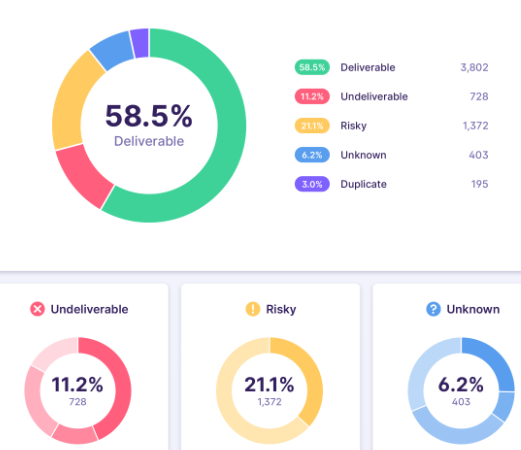
AtData positions SafeToSend within broader email intelligence and data hygiene. It supports file, FTP, and API movement through InstantData, with syntax, ISP rules, typo correction, role or risk detection, and engagement scoring. Its unit rates are $0.008 at 5,000 credits, $0.007 at 50,000, $0.006 at 100,000, and $0.005 at 500,000. A 5,000-credit tier costs $40.
We find data-hygiene value and responsive support, while interface learning appears in criticism. AtData fits teams that want richer email intelligence rather than a binary email list scrubber, though, as a smaller buyers you should check whether added breadth justifies its more enterprise-oriented workflow.
| Service | Practical advantages | Material limitations |
|---|---|---|
| Verifalia | Configurable multi-pass depth; 25 daily credits; large file limit | Exact USD packs are unavailable; deeper checks take more time and credits |
| Mailfloss | Daily supported-ESP cleaning; clear monthly plan prices | Old Tool |
| Emailable | Verification plus deliverability; API, widget, and integrations | Current USD pack are unavailable; our reports remain mixed |
| AtData | Clear tier unit rates; file, FTP, and API paths; broader intelligence | More enterprise-oriented |
Four bonus email list cleaning services we checked
We kept four other services visible. Our scope priority and unresolved commercial evidence kept them outside our featured 15.
Twilio SendGrid Email Validation is available with Email API Pro and Premier Plans, rather than as a simple standalone cleaner tool. Pro Plan starts at $89.95 per month and includes 2,500 validations; Premier includes 5,000. Its asynchronous bulk API can accept up to one million addresses. This is logical for an existing SendGrid Pro or Premier customer, but Essentials does not include validation.
ListClean has bulk upload, APIs, and multiple classifications, it has free-credit plan. You can confirm the current domain, quote, free allowance, credit rules, and service terms directly before purchase.
BriteVerify supplies clear operational documentation: a real-time limit of 500 checks per key per minute, bulk jobs up to one million records, and an average bulk rate around 4,000 per minute. It lists $0.01 per email up to 250,000, while some of our users often mention ease and cost at scale. You should verify the quote directly because no public official tier table was found.
Proofy offers a $4 paid trial for 1,000 checks, they have rates from $0.008 to $0.001 per address, non-expiring credits, free duplicate and unknown handling, and 60-day automatic deletion. Recently we observed a few complaint about bad addresses marked valid.
SendGrid is suite-entitled, ListClean has conflicting pricing, BriteVerify leans toward contact and enterprise workflows, and Proofy fell outside the 15 priority after required deep and specialist categories were filled.
What current users report, and what their stories cannot prove?
Some of our collected user reviews reveal setup friction, but they cannot create controlled accuracy comparisons. We use them to identify pilot questions, not to create a verdict. Users show recurring praise for easy uploads and integrations across NeverBounce, Kickbox, Reoon, Emailable, AtData, and BriteVerify.
We found mixed ZeroBounce bounce outcomes, a Clearout speed concern, and one MillionVerifier classification complaint. Later we founf, list source, sending setup, campaign behavior, and domain mix were uncontrolled, so we do not combine those anecdotes into percentages.
Verified or qualified cost for 10,000 email checks
Compare payable credit cost for the same 10,000-address scenario. Hatched bars and an asterisk mark calculated, starting-rate, qualified-tier, or vendor-supplied values.
| Service | Cost | Relative cost | Basis |
|---|---|---|---|
| Reoon | $11.9 | Published pack | |
| Bouncer | $60 | Published pack | |
| Proofy* | $80 | Calculated ceiling | |
| AtData* | $80 | Qualified tier | |
| MailerCheck | $100 | Published unit rate | |
| Kickbox* | $100 | Vendor-supplied | |
| Xverify* | $100 | Starting rate | |
| BriteVerify* | $100 | Vendor-supplied | |
| ZeroBounce | $129 | Published pack |
Limitations: Pack rules, taxes, currencies, subscriptions, minimum purchases, and free treatment of duplicates or unknowns differ. Price does not measure accuracy. Confirm tier applicability for AtData, Proofy, Xverify, Kickbox, and BriteVerify before purchase.
You can shortlist tools by your business workflow
Form a two- or three-service pilot from these workflows, then confirm prices and data terms for each tools.
For occasional CSV cleanup, start with transparent Pay-as-you Go candidates such as Bouncer, Reoon, or MailerCheck. If your email list contains many business domains, inspect catch-all handling before deleting anything.
For recurring ESP hygiene, Mailfloss provides the clearest automation-first proposition. Confirm your specific ESP. An ActiveCampaign review, Klaviyo review, or Omnisend review can help you inspect the sending side of that flow.
For signup-form or API prevention, choose a service with well documented real-time responses, stable authentication, rate limits that match peak traffic, and categories your application can store.
For high-volume cost control, Reoon has a clear low 10,000-credit price, while DeBounce starts with a lower floor at larger scale. AtData publishes declining unit tiers.
For an existing SendGrid stack, validation on Pro or Premier can reduce another integration. Read our Campaign Monitor review or Drip review only when those platforms are part of your actual alternative path.
For a retention-sensitive team, Clearout publishes configurable 1-45 day retention and Proofy documents 60-day automatic deletion. Bouncer has EU storage. Request a current DPA, deletion process, subprocessors, and security evidence from every finalist rather than treating a badge as enough.
Conclusion: choose a cleaner tool you can operate and audit
After comparing price plans, data flow, and operational limits, our conclusion is simple: a best email list cleaning service is conditional. MailerCheck is approachable for small common-ESP teams. Bouncer and Reoon are especially usable Pay-as-you Go reference points. ZeroBounce and Emailable make more sense when deliverability tools will be used. Hunter fits a combined discovery and verification process. Mailfloss addresses recurring ESP hygiene, while Clearout offers useful automation and published retention control. AtData extends into broader email intelligence for an enterprise stack.
I would not buy from a comparison table alone. You should Export a representative sample that includes consumer and business domains, known invalids, known valids, duplicates, role accounts, and prior unknowns. Run that same permitted sample through finalists. Compare category definitions and repeatability, not vendor accuracy percentages built from different datasets. Decide in advance with your team, whether risky and catch-all records will be sent, suppressed, or reviewed.
Then inspect the expected bill. Confirm credit pack size, minimum payment, expiry, duplicate treatment, unknown treatment, catch-all or enrichment surcharges, subscription rollover, tax, and overage. Recheck every price directly. If you need a free email list cleaner for evaluation, make sure its allowance is large enough to represent your domain mix rather than simply accepting the biggest free number.
Finally, review operations: API limits, bulk caps, native integration, export fields, retries, data location, retention, deletion, DPA, and support route. A verifier should improve decisions without erasing context your team may need later. Buy the workflow you can explain, monitor, and reverse. Revisit the policy as customer acquisition sources change, and keep these email verification process separate from consent, engagement pruning, suppression compliance, and inbox-placement monitoring. Record who owns each rule, when quotes were checked, and when a retained risky segment should be reviewed again.
For a final check, use our guide to how we evaluate email tools and document why each finalist passed or failed your pilot.
Frequently asked questions:
Is email list cleanup automated?
Yes, it can be. Native ESP connections, scheduled cleaning, APIs, and signup widgets automate different stages, but your team must still define how valid, risky, unknown, catch-all, and duplicate results are handled.
How often should a small business clean an email list?
Clean before an important send when a list is old or imported, and use recurring checks when new records enter frequently. Your bounce trends, acquisition sources, and campaign cadence should set frequency.
What is the difference between an email list cleaner and double opt-in?
A cleaner assesses address validity and risk. Double opt-in records a subscriber confirmation. Neither replaces consent records, suppression rules, or engagement management.
Can an email scrubbing service guarantee inbox placement?
No. Email scrubbing services can reduce address risk, but sender reputation, authentication, content, recipient behavior, and provider filtering still affect delivery and placement.
What should an email list cleaning API return?
Look for a clear status, reason, risk category, normalized address, disposable or role flags, catch-all or unknown state, and traceable request response. Keep raw categories available for policy changes.
Is a free email list cleaner enough for a business campaign?
It may be enough for a representative pilot or very small file. Check whether the allowance covers your domain mix and whether free results include every category and export field you need.
How should catch-all and unknown addresses be handled?
Do not delete them automatically without context. Segment them, consider source and engagement, apply a cautious send policy, and monitor bounces because receiving-server behavior can change.

