
 Connor Reynolds

Your email subscriber database can grow from 50,000 to 100,000 contacts without doubling business value, yet an enterprise email contract can more than double your cost, after you count profile definitions, send allowances, brands, users, security, and overages. A low starting price plan may exclude SSO, dedicated IP support, migration, validation, or peak-month volume. A generous contact allowance can still become costly when every recipient and send consumes a credit.
Deliverability adds another risk. An ESP can report delivery while messages land outside the primary inbox. Finance needs a predictable commitment, IT needs identity and audit controls, and your lifecycle team needs automation for customer data. We compare enterprise email marketing tools through a common operating scenario, not starting prices alone.
Our review covers pricing, sends, automation, segmentation, personalization, deliverability, permissions, integrations, API use, support, and scalability. We checked research on October 19, 2026. ESP vendor website establishes mechanics, and Sprout Scores come only from our product review context pages. Our selection methodology explains the approach.
Short answer: match each ESP to your operating constraint
We recommend starting with fit, then test cost. MailerLite suits lean newsletters; Brevo and Mailjet suit send-led programs; Klaviyo favors ecommerce data; ActiveCampaign favors CRM automation; and Sender is the cost-conscious high-volume uses.
| Product | Best fit | 50K / 100K+ price | Pricing and sends | Enterprise control | IP and API | Main limitation | Sprout Score |
|---|---|---|---|---|---|---|---|
| MailerLite | Lean newsletter team | Quote / Quote | Subscribers + custom sends | Unlimited seats; SSO | Dedicated IP add-on; API/webhooks | Lighter governance | 9.1/10 |
| Brevo | Large database, multiple entities | Quote / Quote | Custom sends; unlimited contacts | Unlimited seats, sub-orgs, SSO | One IP; SMTP/API | Workflow depth | 6.8/10 |
| Klaviyo | Ecommerce behavior | Sales quote / Sales quote | Active profiles + allowance | Paid-plan SSO | APIs; separate domains | Profile-growth cost | 9.1/10 |
| Mailjet | Marketing + transactional | Custom quote / Custom quote | Sends; unlimited contacts | Roles; SSO at Premium 100K+ | API/SMTP; Dedicated IP at 100K+ | Large-tier price | Unavailable |
| ActiveCampaign | CRM lifecycle automation | Quote / Quote | Contacts; 15x sends shown | SSO, team, five users | API; Dedicated IP | Scaling and reporting effort | 6.8/10 |
| Sender | Cost-sensitive volume | Quote / Quote | Annual; unlimited emails | Unlimited seats, SSO, logs, SLA | Transactional; Dedicated IP | Integration depth | 6.8/10 |
Our feature comparison can reduce your longlist. Let your contract and pilot decide.
Calculate enterprise requirements before you book demos
Start with 50,000 and 100,000 active, marketable contacts, then calculate four, eight, and twelve sends per contact monthly. You get 200,000, 400,000, and 600,000 sends at 50K, or 400,000, 800,000, and 1.2 million at 100K. This exposes how contact-priced software differs from send-priced enterprise email marketing platforms under comparable workloads.
Define every billing unit clearly in writing before you commit. Ask whether duplicates, inactive profiles, suppressed addresses, API messages, test sends, and transactional traffic will count toward your bill. You should also document your brands, subaccounts, users, roles, SSO or provisioning requirements, audit-retention needs, data-residency requirements, export options, and SLA expectations.
If you are considering a dedicated IP, make sure your sending volume is predictable enough to justify the warmup process and the responsibility of managing your own reputation. For irregular sending patterns, you may find that a well-managed shared pool is a better fit because you can avoid taking on dedicated reputation management unnecessarily.
Use our email marketing cost calculator to organize scenarios, migration, and governance costs.
Six primary enterprise ESP evaluations we did
MailerLite Enterprise Plan: best for a lean newsletter operation
MailerLite Enterprise plan is custom-priced, with custom sending volume, unlimited seats, priority support, a success manager, account review, training, and deliverability support. We found an eligibility conflict: one page refers to 200K+ subscribers, while another invites smaller organizations to contact sales. At 50K or 100K subscribers, you should confirm Enterprise plan access in writing.
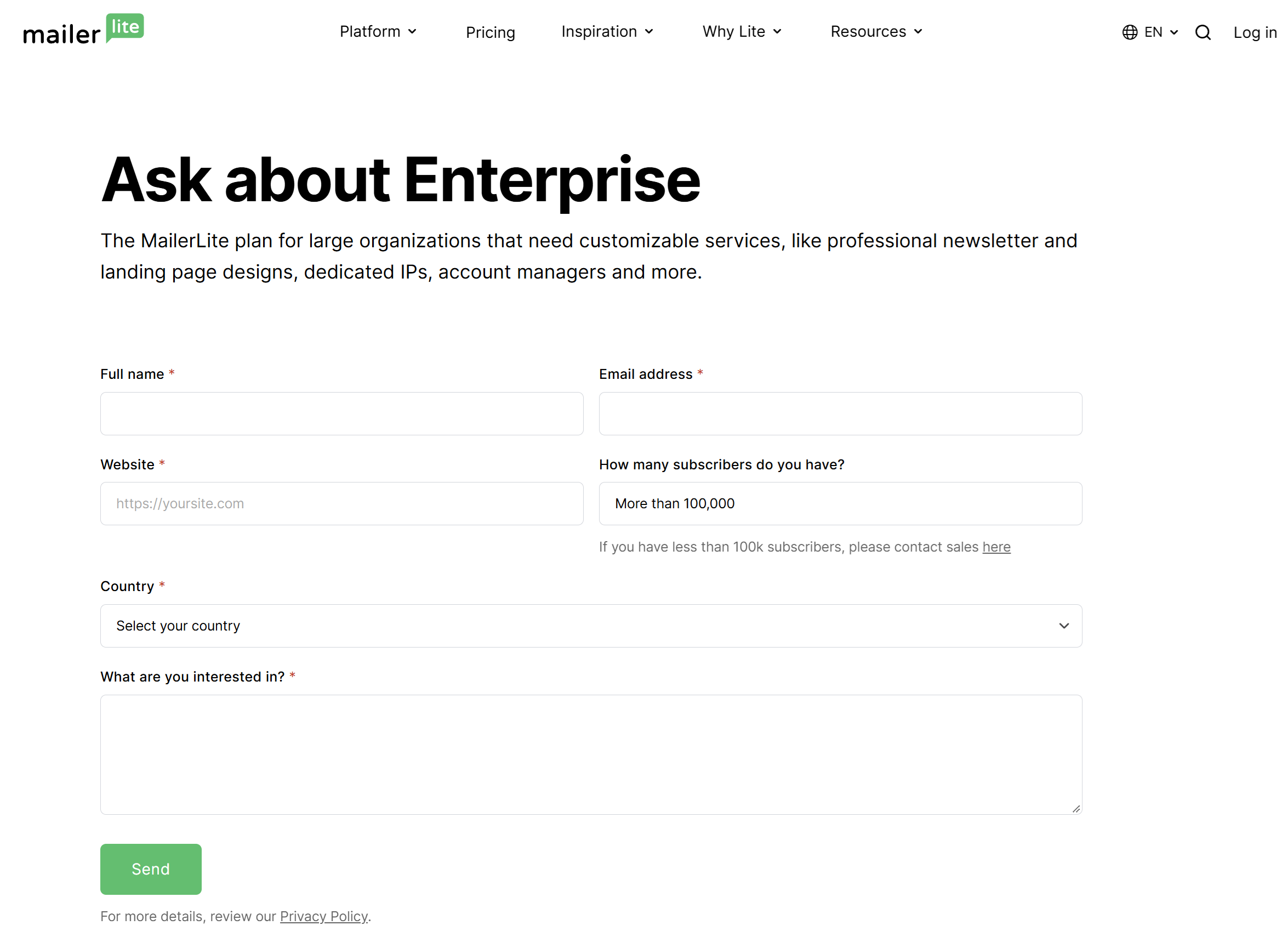
When you import contacts, groups and segments feed triggers, conditions, A/B splits, webhooks, dynamic blocks, and reporting. With 150+ integrations and an easy-to-use workflow, MailerLite can work well for your smaller central team. If you send 50,000+ emails per week, you can also consider a dedicated IP as an add-on. Users generally like this platform for its ease of use and customer support, but you may find limitations with automation depth, reporting, verification speed, latency, and billing based on active subscribers.
| MailerLite strengths | MailerLite limitations |
|---|---|
| Accessible workflow; unlimited Enterprise plan seats | Enterprise plan audience threshold is contradictory |
| Onboarding and deliverability support | SSO and deeper governance vary |
Verdict: Before you decide that it is the best email marketing software for your large business team, ask their sales team to clarify subscriber billing, custom sending limits, SSO, audit requirements, dedicated IP costs, and reporting options.
Brevo: best for large stored databases and multi-entity governance
Brevo Enterprise plan combines custom send volume with unlimited contact storage. That structure can favor a 100K-contact team that mails selectively because each email to one contact consumes one credit. Enterprise plan includes unlimited seats, sub-organizations, custom objects, warehouse or SFTP capability, SAML SSO, an SLA, a success manager, and one dedicated IP.
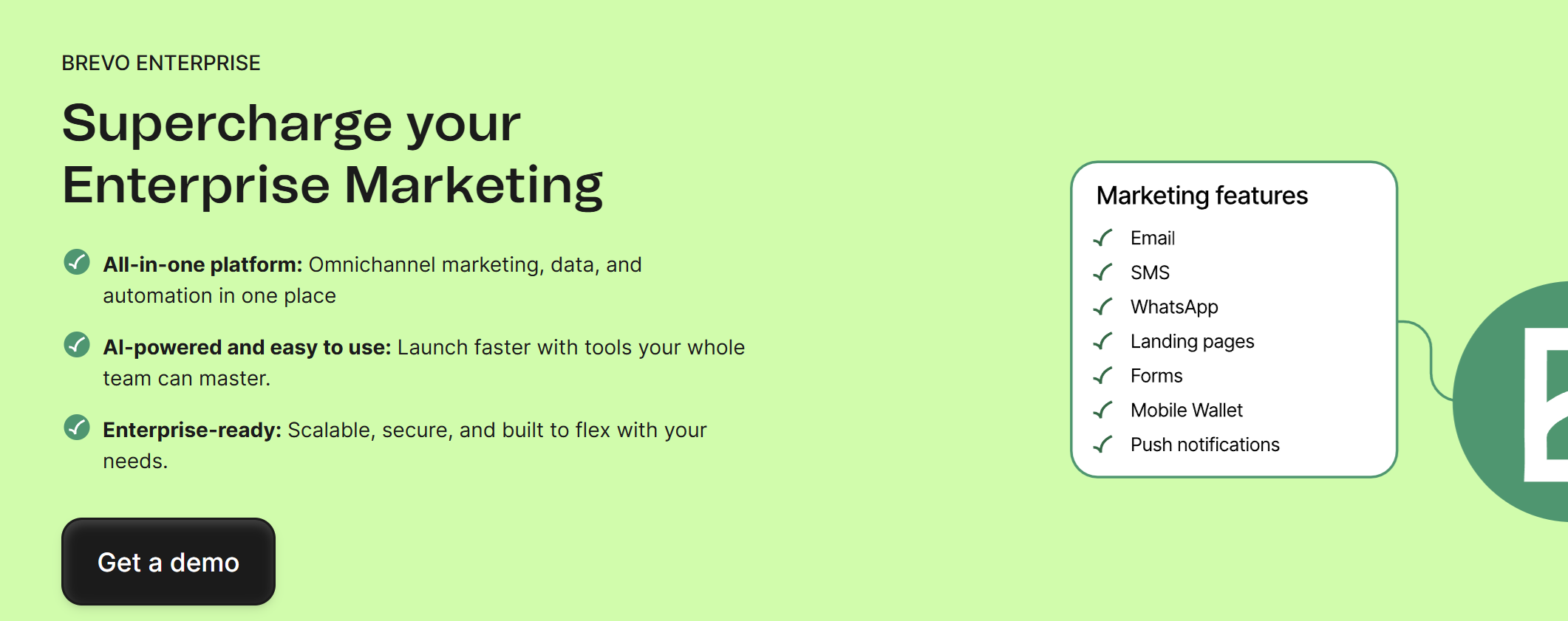
You can use CSV files, integrations, tracking, APIs, and webhooks to bring customer data and events into your segments, automations, campaigns, and reports. We see the clearest fit in multichannel or regional operations needing central control. A dedicated IP requires warmup. Users generally like Brevo for its ease of use and ability to bring multiple channels together. However, you may experience slower editor latency, limits with workflows or reporting, support issues, and concerns about shared resources.
| Brevo strengths | Brevo limitations |
|---|---|
| Send-based economics with unlimited stored contacts | Enterprise plan TCO remains quote-only |
| Strong multi-organization and SSO controls | Advanced workflow and reporting need pilot proof |
Verdict: Shortlist Brevo when your database size exceeds monthly reach or when sub-organizations and centralized governance are essential for you. It has a Sprout Score of 6.8/10. You should request 4x, 8x, and 12x email send volume quotes, test complex automation and warehouse export, then confirm peak overage and dedicated-IP escalation terms.
Klaviyo: best for ecommerce behavior and profile-level orchestration
Klaviyo charges based on your active profiles and email sending limits. Suppressed profiles are not included in your billable active profile count. If you need more sending capacity, you can pay for the next tier at the current rate. However, if you regularly need extra capacity, upgrading your plan may be more cost-effective. We did not capture reliable 50K or 100K contact volume totals, so compare Klaviyo alternatives against account-specific quotes.
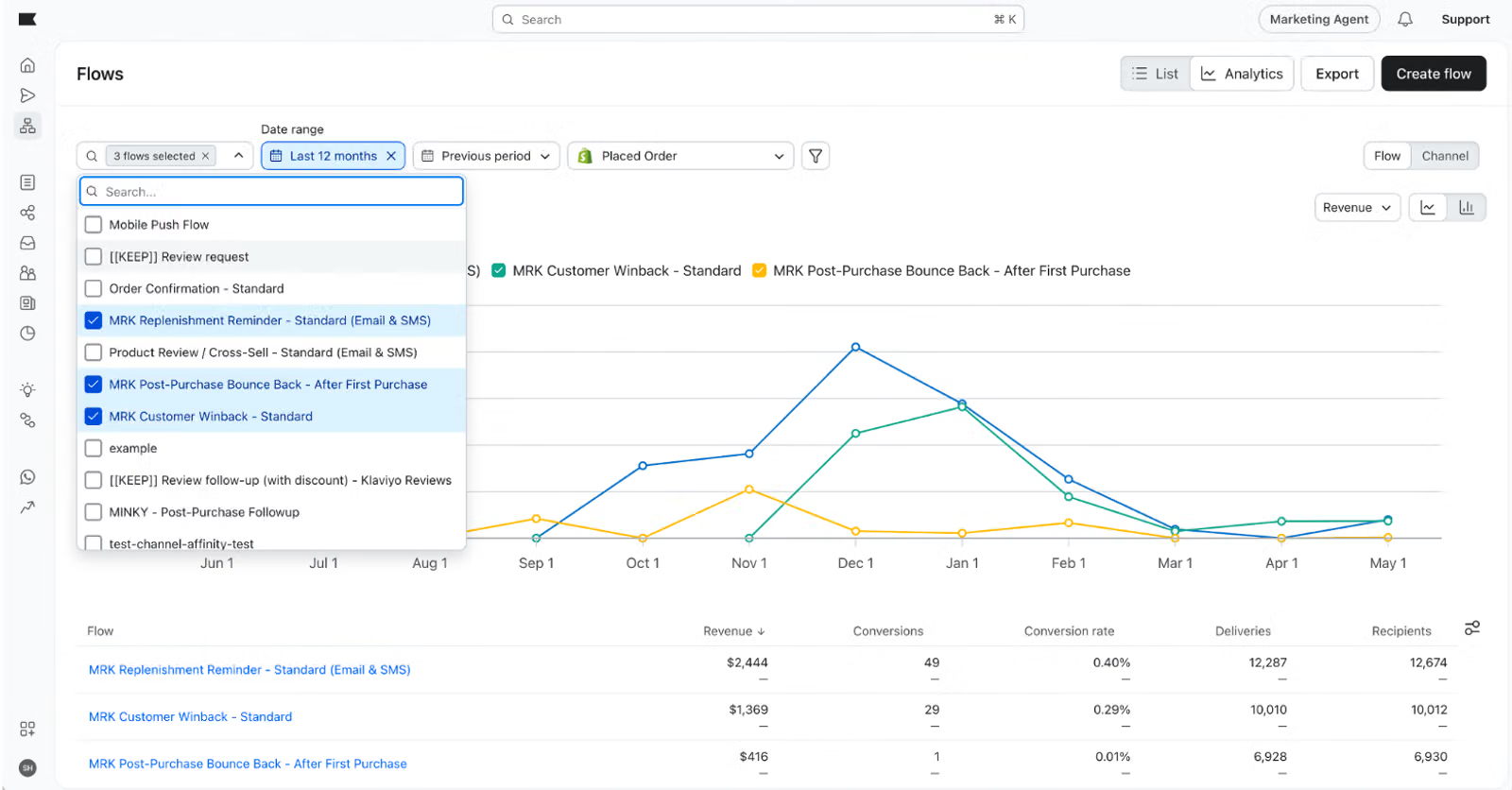
With commerce and CRM integrations or APIs, you can connect your customer data and bring profiles, events, catalog data, segments, flows, campaigns, and analytics into one system. If you are on a paid plan, you can also use SAML 2.0 SSO for more secure access. However, you should verify whether JIT provisioning, SCIM, and role mapping are supported for your specific setup. You can also use separate branded domains to keep different types of email communication isolated.
We often highlight its strong ecommerce automation capabilities, but you may also encounter a learning curve, higher costs as your contact list grows, challenges when interpreting reports, and occasional data-sync edge cases.
| Klaviyo strengths | Klaviyo limitations |
|---|---|
| Deep ecommerce event and profile workflows | Active-profile growth can raise cost quickly |
| Strong segmentation, flows, integrations, and SSO | Advanced setup and reporting require expertise |
Verdict: Klaviyo is our strongest fit for ecommerce teams that turn behavioral data into measurable lifecycle decisions. Its 9.1/10 Sprout Score does not make it an automatic winner for a newsletter-led enterprise. Validate identity sync, suppression policy, role mapping, peak send flexibility, and independent inbox tests.
Mailjet: best for collaborative marketing and transactional delivery
Mailjet bases paid core tiers on monthly email volume and allows unlimited contacts. With the Premium plan, you get access to automation, segmentation, dynamic content, A/B testing, statistics, collaboration, and user roles. If you are considering the Premium 100K+ tier, you can also qualify for SSO, one dedicated IP, and 2,000 validations. However, you should compare the 50K Premium tier carefully because its included features differ.
If you need more hands-on support, the Custom plan adds a technical account manager, onboarding, deliverability consulting, monitoring, permissions, subaccounts, and an SLA. We recommend matching these inclusions to your team’s requirements so you can determine which plan gives you the level of support and control you actually need.
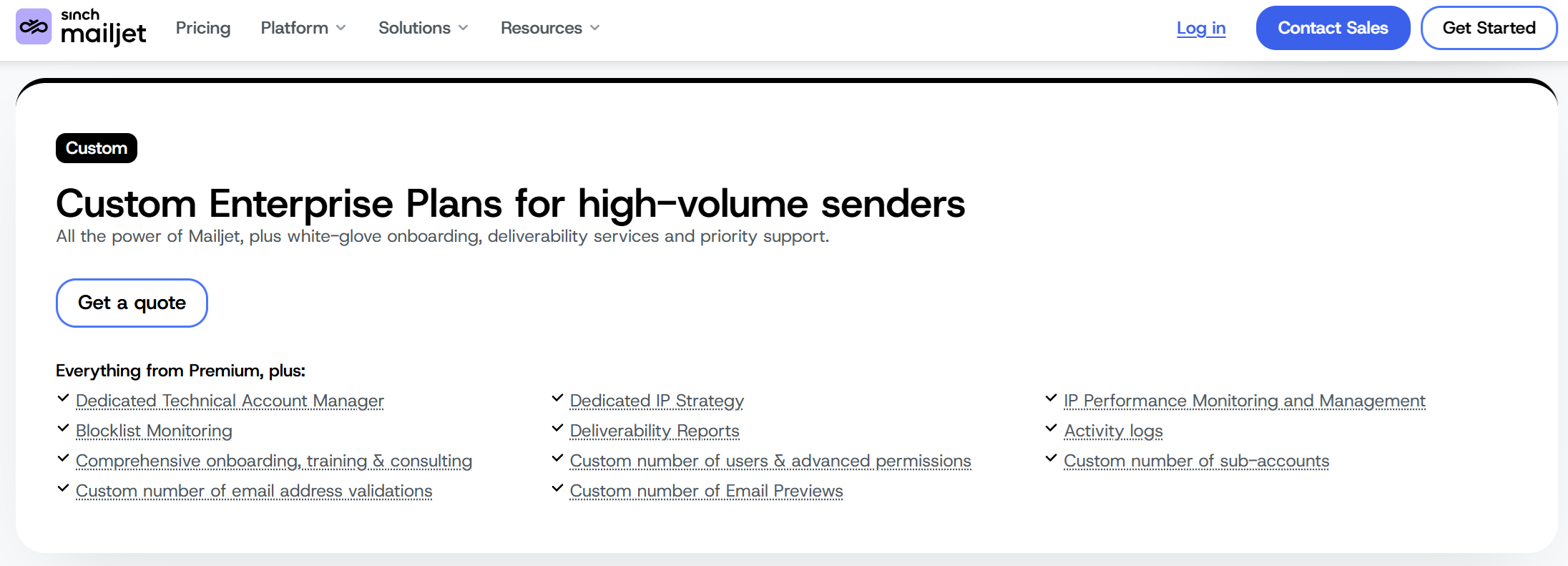
With integrations, APIs, or SMTP, you can move your contacts and events directly into your campaigns, automation, statistics, and webhooks. This allows you to keep your marketing and application emails closely connected, so you can manage your customer communications more efficiently.
When you are comparing pricing, you should verify the latest pricing before making a decision.
We find API capabilities and a flexible builder useful. However, you should also consider reported concerns around customer support, account reviews, bounced emails, and blocking in your country.
| Mailjet strengths | Mailjet limitations |
|---|---|
| Email send-volume structure and unlimited contacts | Current large-tier totals |
| Marketing collaboration plus API/SMTP | Important SSO and IP benefits begin at 100K sends |
Verdict: We suggest that you consider Mailjet when your monthly email send volume is a more important cost driver than the number of contacts you store, particularly if your team manages both promotional and transactional workflows in one place.
Before you commit, run tests for list validation and emergency escalation so you can see how the platform handles issues when they arise. We also recommend confirming your pricing, support tier, dedicated-IP plan, subaccount options, and overall terms in writing for your region. This gives you a clearer view of what you will receive and helps prevent unexpected limitations later.
ActiveCampaign Enterprise plan: best for CRM-linked lifecycle automation
ActiveCampaign Enterprise plan uses quote-led pricing. It lists premium segmentation, unlimited automation actions, CRM and ecommerce integrations, conditional or predictive content, attribution, custom objects, SSO, and an account team. Five users and sends at 15 times contact limit imply 750K sends at 50K contacts and 1.5 million at 100K, subject to contract.
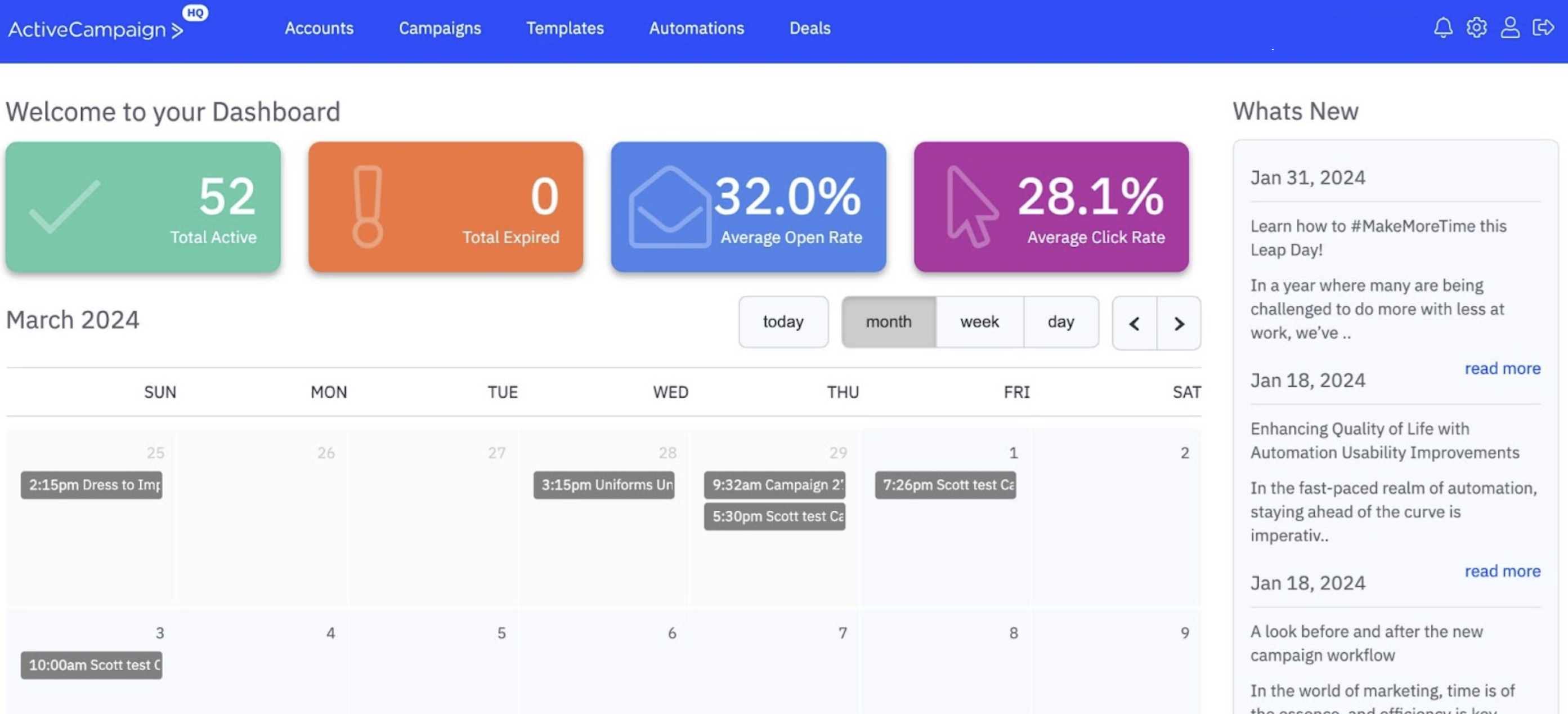
You can connect your CRM, commerce platform, website, and contact behavior to bring data into your segments, goals, automation, campaigns, and reports. This gives you the flexibility to build more complex nurture and retention journeys.
However, you should consider how the five included users fit into your procurement needs, particularly if you have a larger team or multiple stakeholders who need access. Dedicated-IP terms and exact pricing for the larger tiers also remain region focused, so you should verify these details before making your final decision.
Users often values its automation and targeting capabilities. At the same time, they also report for potential contact-cost growth as your database expands, as well as the onboarding effort involved. Performance and reporting may also require additional attention depending on how complex your campaigns and measurement needs are. Review ActiveCampaign alternatives if analytics or seats dominate.
| ActiveCampaign strengths | ActiveCampaign limitations |
|---|---|
| Deep behavior-led automation and CRM alignment | Quote-only price grows with contacts |
| SSO, custom objects, attribution, account team | Five shown users and reporting effort need review |
Verdict: ActiveCampaign belongs on your shortlist when your team can use advanced automation with disciplined data. Its 6.8/10 Sprout Score and our feedback make operational fit worth close review. You should Price extra seats, migration, exports, contact cleanup, and support response, then prove one complex journey end to end.
Sender Enterprise plan: best for cost-sensitive high-volume teams
Sender Enterprise plan is an annual custom contract with unlimited emails and role-based seats, permissions, audit logs, SAML v2 SSO, an SLA, a success manager, and priority 24/7 support. Standard plan and Professional plan use 12x and 24x subscriber sends, while Enterprise plan has unlimited sends. Your contract still needs definitions for subscriber ceiling, throughput, and fair use.
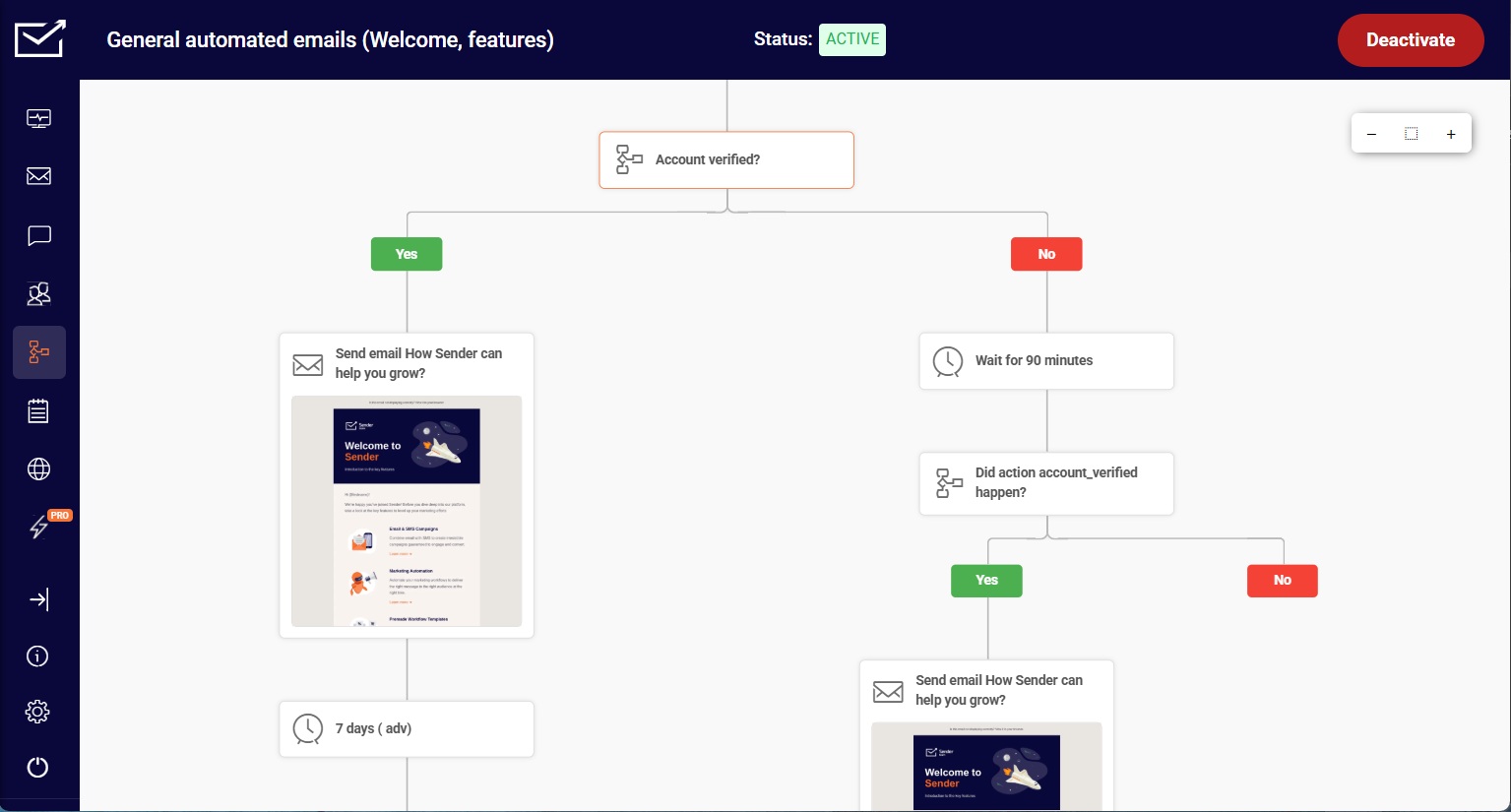
With integrations or APIs, you can connect your subscribers and events to segments, email and SMS automation, reports, webhooks, and transactional email. If you need a dedicated IP, you can request one on the Professional plan from 20K subscribers, and it is recommended when you send more than 500K emails per month. If you are considering Enterprise plan, you should confirm exactly what dedicated-IP options and entitlements are included in your region based plan before committing.
We often highlight its setup and automation capabilities. However, they also encounter mixed experiences with segmentation, reporting, integrations, templates, customer support, and occasional delays.
| Sender strengths | Sender limitations |
|---|---|
| Unlimited Enterprise plan email sends and role-based seats | Fair-use and throughput details are contractual |
| Marketing, SMS, and transactional coverage | Enterprise plan integration and reporting depth need proof |
Verdict: We would choose Sender as a finalist when volume and seat economics lead. Its 6.8/10 Sprout Score does not remove the need for a pilot. Before you commit, you should test how this platform handles multi-domain workflows, peak sending volumes, reporting exports, API events, and escalation requests. This gives you a clearer picture of how it will perform under your actual operating conditions.
If you are considering a custom quote, confirm your dedicated-IP entitlement and identify any integration gaps before you accept the offer. We recommend getting these details in writing so you know exactly what your plan includes.
Bonus platforms for specialized enterprise structures
Campaign Monitor fits organizations prioritizing design collaboration, multi-brand or multi-team control, account support, and custom DPA or purchase-order billing. Enterprise plan is custom. 50K benchmarks are $397 monthly for Lite plan, $644 for Essentials plan, and $1,074 for Premier plan, but these are self-service references, not Enterprise plan quotes. Duplicate active addresses across lists can be billed repeatedly. It has a Sprout Score of 6.8/10.
We recommend that you consider Dotdigital for parent-child accounts, cross-account analytics, SSO, multiple storefronts and languages, and warehouse export or reverse sync. Pricing, dedicated-IP terms and onboarding scope, so include it only in a requirements-led RFP.
Iterable fits sophisticated cross-channel orchestration requiring organization and project controls, SAML SSO, US or EU data-center endpoints, project-scoped API keys, Smart Ingest, and warehouse flows. Professional plan services cover migration, schema planning, integrations, training, and shared or dedicated IP warmup. Pricing is quote-only; it has a Sprout Score of 7.7/10.
Treat deliverability and list hygiene as operating disciplines
Require SPF, DKIM, and DMARC alignment, branded domains, bounce and complaint handling, portable suppression, consistent cadence, segmentation, and escalation. Dashboard delivery means server acceptance, not inbox placement. When you are comparing inbox monitoring, ask each ESP vendor for mailbox mix, measurement method, and test date.
A dedicated IP can help when your volume sustains warmup and your team owns reputation. Shared infrastructure can suit irregular or lower volume. Define blocklist escalation, throttling, complaint controls, and remediation ownership either way.

MailerCheck supports bulk, integration, and API verification with valid, invalid, typo, mailbox full, catch-all, unknown, and disposable results. Its displayed 1,000-credit tier is $10, credits do not expire, and the minimum is 1,000. You should review catch-all and unknown addresses instead of deleting them blindly, while preserving consent and suppression state. Verification reduces avoidable bounces but cannot promise inbox placement. It has a Sprout Score of 8.9/10. Our email list verification guide gives more information.
Move right for richer behavioral orchestration and up for multi-entity, security, data, and infrastructure control. Choose the lowest sufficient quadrant, then validate price and operating effort.
Separate notification email when business continuity requires it
Password resets, receipts, and alerts should not lose delivery because a promotion damages reputation. We suggest that you map the flow as application trigger to API or SMTP, distinct sending subdomain and IP pool where justified, then event webhooks into suppression, monitoring, warehouse, or CRM systems. Compare that architecture through our transactional email API reviews.
Amazon SES can be a good fit if you have an engineering-led team and want more control over your email infrastructure. You’ll pay $0.10 per 1,000 outbound messages, plus $0.12 per GB of attachment data. If you need a standard dedicated IP, you will pay $24.95 per IP each month, while managed dedicated IPs start at $15 per account per month, plus applicable volume charges. You will also need to account for your engineering time, monitoring, support, and any other AWS services your setup requires.
MailerSend provides a more managed transactional API, SMTP, webhooks, logs, templates, and domain authentication workflow. Professional plan overage is $0.90 per 1,000. Dedicated IP costs $50 monthly. Official eligibility wording conflicts between 500K monthly and 100K weekly, so confirm it with sales. Use our transactional API price calculator to compare identical message volumes.
Use published prices carefully in your RFP
Quote required or reliable 50K total price not available: MailerLite Enterprise plan, Brevo Enterprise plan, Klaviyo large tier plan, Mailjet Custom plan, ActiveCampaign Enterprise plan, Sender Enterprise plan, Dotdigital plan, and Iterable plan.
These figures show plan spread within one provider, not enterprise TCO or cross-provider value. Never treat quote-only plans as $0.
Ask for 50K and 100K contacts at 4x, 8x, and 12x monthly cadence. Add onboarding, migration, validation, IP and warmup, SSO or provisioning, roles, audit retention, brands, API calls, SLA credits, peak overage, support, data export, and exit assistance. That turns marketing claims into comparable commercial terms.
How we recommend making the final paid-plan decision
Best enterprise email marketing software has the lowest defensible cost and risk for your operation. Start with Year-1 TCO = subscription + onboarding + migration + IPs + security add-ons + seats + validation + peak overage + engineering or agency cost. Then calculate effective CPM = Year-1 TCO / annual delivered attempts x 1,000 and cost per active contact = Year-1 TCO / average annual active contacts. These figures expose cost hidden by unlike billing structures.
Next, translate any higher price into an outcome threshold. Use break-even incremental conversions = annual TCO difference / contribution margin per conversion. If one option costs $24,000 more each year and contribution margin is $80 per order, it needs 300 additional annual orders to break even. That calculation is a decision scaffold, not a product performance claim. Our email marketing ROI calculator helps with latest price plans of ESP.
Now narrow by operational fit. We recommend choosing MailerLite for lean newsletters, Brevo for selective sends or multiple entities, Klaviyo for ecommerce data, Mailjet for collaborative marketing plus API, ActiveCampaign for CRM lifecycle work, and Sender for cost-sensitive volume. Dotdigital adds global parent-child control. Iterable adds advanced cross-channel architecture. Amazon SES or MailerSend can isolate notifications.
Use a representative segment, two mailbox cohorts, one automation, a peak-volume rehearsal, and an escalation test. Verify identity, suppression, consent, roles, webhooks, exports, and deletion. Before signing, export a template, event history, and suppression file. Our ESP migration effort calculator surfaces work that a subscription quote misses.
Finally, request a three-year commercial view. Define billable contacts, duplicates, inactive and suppressed profiles, send credits, API messages, extra seats, brands, SSO, dedicated IPs, validation, overages, SLA credits, and renewal increases in writing. Before the pilot, record remediation ownership and maximum acceptable recovery time. Recheck every price before purchase.
After comparing all platforms on the same workload, keep your recommendation conditional. Select an ESP only after it passes your own security and deliverability review, completes the pilot with acceptable effort, and wins your normalized TCO calculation under expected and peak volume. No single choice fits every enterprise; a clear condition is more useful than false certainty.
If your comparison requires procurement, lifecycle, finance, and IT coordination, Sprout24 offers an email marketing platform selection service to structure the evidence and decision.
Frequently asked questions
What is an ESP for large enterprises?
It supports high-volume lifecycle email with scalable automation, data, reporting, security, governance, support, and deliverability controls.
How much does enterprise email marketing software cost at 50K or 100K contacts?
Most providers require quotes. Compare 50K and 100K contacts at 4x, 8x, and 12x cadence, then add implementation and governance.
Is contact-based or send-based pricing better for a large business?
Send pricing can favor selective mailings; contact pricing can simplify high-cadence forecasts. Your billing definitions still determine actual cost.
When does an enterprise sender need a dedicated IP?
Choose one when volume is predictable and your team can manage reputation. Shared pools can suit irregular volume.
How should marketing and transactional email be separated?
Use distinct subdomains and, where justified, IP pools or services. Coordinate events and suppressions through webhooks.
Which security and permission controls should an enterprise ESP provide?
Evaluate SSO, provisioning, roles, logs, subaccounts, residency, retention, response, exports, and SLA terms.
Can email list cleaning improve deliverability?
Verification reduces avoidable bounces but cannot guarantee inbox placement or replace consent and suppression records.


