
 Pritha Bose

Choosing among Clickfunnels Alternatives is no longer a simple page-builder comparison. A marketing team may need landing pages, email automation, CRM records, checkout flows, courses, WordPress control, or some combination of all six. A platform can look cheaper than ClickFunnels and still cost more once missing parts are added.
That is why this guide starts with workflow, not a winner. We verified current pricing, plan limits, free access, integrations, data flow, and published Sprout Scores on July 22, 2026. We also compared each option with the current ClickFunnels review baseline: Launch is $97 per month, while Scale is $197 and Optimize is $297. ClickFunnels has a published Sprout Score of 7.7/10.
Some alternatives replace nearly an entire funnel stack. Others replace one expensive or awkward layer. Right choice depends on what your team already owns, which data must move between tools, and how much maintenance you want to accept.
Why teams look for new ClickFunnels alternatives?
ClickFunnels remains a broad hosted option, with pages, funnels, checkout, and automation under one account. Yet “similar to ClickFunnels” can mean very different things. A newsletter team may only want a landing page that writes clean subscriber data into an email sequence. An agency may need pipelines, SMS, calendars, and client subaccounts. A WooCommerce team may want to keep every page and order inside WordPress.
Price is another trigger, but headline price needs context. ClickFunnels 2.0 pricing lists Launch at $97 per month or $970 per year. A ClickFunnels cheaper alternative may start at $0, $12, or $18, yet its usable funnel tier might be higher. Simvoly Starter has no funnels. Builderall Core excludes email and ecommerce. OptimizePress Launch provides pages, while Scale adds its funnel and checkout suite. SamCart puts one-click upsells and order bumps on Pro.
For a broader view of automation categories, use our email marketing tools review and ActiveCampaign alternatives alongside this guide.
One pattern became clear during our analysis: replacement scope matters more than feature count. An all-in-one platform may reduce integration seams but increase migration commitment. A focused tool may fit an existing stack beautifully while being a poor standalone replacement. Our guide to email marketing helps explain why subscriber data, consent, segmentation, and delivery deserve as much attention as page design.
How we evaluated these ClickFunnels competitors?
During our evaluation, we separated four evidence types. Official vendor pages support prices, plan limits, free access, and features. Our own research supports published scores and collected reviews. Clearly attributed independent reports add user perspective for selected products. Workflow statements, such as “this setup creates another handoff,” are editorial inferences from our verified product architecture.
Our review methodology uses a ten-step process and approximately 25 testing points. Relevant landing-page criteria include design, ease, conversion tools, integrations, testing, mobile behavior, speed, value, and support. Relevant automation criteria include workflows, CRM and integrations, ease, analytics, email, lead management, scalability, value, and support. You can also read how Sprout Scores work.
MailerLite, GetResponse, Kit, Kajabi, GoHighLevel, and Keap have published Sprout Scores. Eleven other alternatives are marked “Not published Sprout Score available.” A blank score is not a zero, and it does not imply weak quality.
Our review prioritizes five buyer questions:
- What is the lowest plan that can perform the intended funnel job?
- Where does lead, purchase, and campaign data live?
- Which connections are native, and which require another service?
- What will marketing, sales, and operations teams maintain?
- Is the platform replacing a stack, or only one layer?
If your first priority is email rather than checkout, our email tools feature comparison and newsletter tools comparison offer a narrower view.
Quick comparison of 17 alternatives to ClickFunnels
The “usable starting point” below matches the role discussed in this article. It can be higher than the lowest advertised tier.
| Alternative | Usable starting point | Free plan | Native center of gravity | WordPress fit | Sprout Score |
|---|---|---|---|---|---|
| MailerLite | Free; Comfort from $12/mo | Yes | Email, forms, simple pages | Embed/integrate | 9.1/10 |
| GetResponse | Starter $19/mo; Marketer $59/mo for advanced automation | Limited free after trial | Email, automation, funnels | Plugin/forms | 8.5/10 |
| Kartra | Starter $119/mo | No verified free plan | All-in-one funnels | Link/embed | Not published Sprout Score available |
| Perspective | Free; Base $47/mo billed yearly | Yes | Mobile lead funnels | Link/embed | Not published Sprout Score available |
| Thrive Suite | $299 promotional annual; $599 renewal | No | WordPress conversion suite | Native | Not published Sprout Score available |
| Deadline Funnel | Start $49/mo | No | Deadline layer | Works with pages | Not published Sprout Score available |
| Kajabi | Basic $179/mo | No | Creator business suite | Hosted | 8.2/10 |
| Simvoly | Business $36/mo for funnels | No | Sites, funnels, CRM | Hosted | Not published Sprout Score available |
| Kit | Free; Creator $39/mo at 1,000 subscribers | Yes | Creator email | Embed/integrate | 7.9/10 |
| Builderall | Essentials $47/mo for email and ecommerce | No | Broad marketing suite | Can coexist | Not published Sprout Score available |
| SamCart | Core $79/mo; Pro $199/mo for key conversion features | No | Checkout | Embed/link | Not published Sprout Score available |
| GoHighLevel | Starter $97/mo | No | CRM and agency operations | Connects | 7.7/10 |
| Keap | $299/mo, billed $2,988/year | No | CRM and automation | Forms/integrations | 7.8/10 |
| CartFlows | Starter $99/year; $129 renewal | No | WooCommerce funnels | Native | Not published Sprout Score available |
| OptimizePress | Scale $199/year for funnels/checkouts | No | WordPress funnel suite | Native | Not published Sprout Score available |
| SeedProd | Basic $39.50 intro; $79 renewal | No | WordPress landing pages | Native | Not published Sprout Score available |
| Systeme.io | Free; Startup $27/mo | Yes | Budget all-in-one | Link/embed | Not published Sprout Score available |
Narrow email-first choices
Put subscriber count, sending volume, automation needs, and budget into our email marketing calculator, then use the email platform selection guide to compare the resulting shortlist.
Choose architecture before brand
Architecture can be compared reliably by tracing each documented data path in your business. Lead data follows a path: ad or search visit, page or form, contact record, automation, checkout, then reporting. Each handoff is a place where consent, attribution, or purchase context can be lost.
Email-first tools such as MailerLite, GetResponse, and Kit keep lead capture close to nurture. Hosted suites such as Kartra, Kajabi, GoHighLevel, Keap, Builderall, Simvoly, and Systeme.io reduce seams by keeping more modules together. WordPress options such as Thrive Suite, CartFlows, OptimizePress, and SeedProd preserve site control but add hosting and plugin maintenance. SamCart specializes in checkout. Deadline Funnel adds scarcity to a stack. Perspective focuses on mobile lead funnels.
Our analysis became clearer once we compared real workflow shapes rather than long feature lists. If email, CRM, and checkout already work, replacing them may create avoidable migration risk. If data is fragmented across five tools, one suite may simplify reporting. Teams evaluating commerce handoffs can also use our ecommerce email tools comparison and omnichannel feature comparison.
Email-first ClickFunnels alternatives
1. MailerLite: best for simple lead capture and nurture on a small budget
MailerLite is a close ClickFunnels alternative when a team needs forms, landing pages, subscriber records, and email automation more than a complex checkout. Its free plan supports 250 subscribers, 2,500 monthly emails, two users, three visual automations, and one website or landing page. Comfort starts at $12 per month, and Power starts at $25 on published pricing.
Data stays clean because forms and pages write into subscriber records, segments, and automation. More than 100 integrations extend that path, but MailerLite is not a broad CRM or advanced funnel checkout. G2 reviewers commonly praise ease and value, while some report advanced automation, approval/setup, or support limits and achieved Sprout Score is 9.1/10.
For nearby choices, compare MailerLite vs GetResponse, MailerLite vs Mailchimp, or our guide to affordable Mailchimp email alternatives.
| MailerLite pros | MailerLite cons |
|---|---|
| Useful free entry point; email and forms share one subscriber model; low paid starting price | Free caps are small; checkout and CRM depth do not match an all-in-one funnel suite |
2. GetResponse: best email-first bridge toward complete funnels
GetResponse sits closer to ClickFunnels than most email platforms. Starter plan is $19 monthly or $15.58 per month on annual billing. Marketer plan is $59 monthly and adds unlimited automation, sales funnels, and abandoned-cart features. Creator plan is $69 monthly and adds webinars, site, and course features. Paid plans include unlimited landing pages, while a 14-day premium trial can lead into a limited free account.
Here an important decision is tier selection, not just brand. Starter can capture and send, but advanced automation belongs on Marketer. Native integrations and API connections can move ad, commerce, and CRM data into campaigns. TechRadar describes capable automation and broad all-in-one coverage, while noting a learning curve, no full CRM, and no phone support. And Sprout Score is 8.5/10.
For the exact head-to-head comparison, read GetResponse vs ClickFunnels and Kit vs GetResponse.
For teams searching “ClickFunnels vs GetResponse,” practical split between the two is funnel breadth versus email-first automation depth.
| GetResponse pros | GetResponse cons |
|---|---|
| Strong email automation path; funnels and commerce features available; broad integration options | Advanced workflow features raise usable price; not a full sales CRM |
3. Kit: best for creator newsletters and audience ownership
Kit is strongest when landing pages feed a creator audience, not when a team needs a complex order funnel. Its free Newsletter plan supports up to 10,000 subscribers, unlimited landing pages, forms, and broadcasts, plus one basic automation. Creator costs $39 monthly for 1,000 subscribers, while Creator Pro costs $79. Paid plans have a 14-day no-card trial.
Forms, tags, purchases, and integrations update subscriber profiles, which makes Kit a clean nurture center. It also supports simple digital-product and subscription commerce. Yet it is not a full CRM, advanced checkout, or multi-step funnel suite. Sprout Score is 7.9/10.
I would shortlist this platform when a team needs a newsletter engine first and accepts an external sales stack. You can use our Kit vs Mailchimp comparison and list-growth forecast calculator to model your selection decision, when subscriber-based pricing may change.
| Kit pros | Kit cons |
|---|---|
| Generous subscriber allowance on free plan; landing pages and email share tags; creator-friendly workflow | Only one basic automation on free; limited CRM and checkout depth |
Test the email economics
Compare likely campaign return with our email marketing ROI calculator. If these tools still feel too narrow, review Mailchimp alternatives before moving to a larger all-in-one suite.
All-in-one platforms for broader funnel replacement
4. Kartra: best for replacing several connected funnel tools
Kartra starts at $119 monthly or $99 per month with annual billing. Starter includes 2,500 leads, 15,000 emails, 100 pages, 20 products, two memberships, and an additional team member. We found no verified free plan or trial as of our July 22, 2026 fact check.
Kartra keeps pages, email, lead behavior, checkout, offers, and memberships inside first-party modules. That can reduce synchronization work when a team would otherwise connect a page builder, sender, cart, and membership system. The counterweight is commitment: migration touches more records and workflows, and entry cost is higher than an email-first tool.
We would choose this tool when replacing several funnel layers is more valuable than preserving existing Clickfunnels tool. Teams that still need a CRM comparison can review HubSpot alternatives before consolidating.
| Kartra pros | Kartra cons |
|---|---|
| Pages, email, checkout, behavior, and memberships share data; generous page allowance | $119 monthly entry; no verified free access; larger migration commitment |
5. Kajabi: best for courses, coaching, and memberships
Kajabi turns a funnel into a creator-business workflow. Basic is $179 monthly or $143 per month on annual billing. It includes five products, 2,500 contacts, one site, one community, two admins, unlimited funnels, unlimited landing pages, and unlimited emails. A 14-day trial is available.
Products, pages, email, payments, subscriptions, and automation share customer records. That removes several handoffs for a course or membership team. It can be excessive when a marketing team only needs landing pages, and contact or product caps still matter. Kajabi has a verified Sprout Score of 8.2/10.
Our recommendation changed after comparing scope: Kajabi is not merely a landing page alternative, it is a best alternative to Clickfunnels. Read ClickFunnels vs Kajabi before moving content, offers, and members together.
| Kajabi pros | Kajabi cons |
|---|---|
| Native products, community, email, checkout, and automation; few core data handoffs | High price for page-only use; product, contact, and admin caps need planning |
6. GoHighLevel: best for agencies and multi-location lead operations
GoHighLevel starts at $97 per month with three subaccounts. Unlimited is $297, and Pro is $497. Official material describes unlimited contacts and users, plus CRM, funnels, websites, email, SMS, calendars, workflows, payments, invoices, and order forms. Its 14-day trial requires a card.
This is an operations platform as much as a funnel builder. Contacts, conversations, appointments, pages, and payments can share records. Agencies gain a clearer path across clients or locations, but setup is more involved, and messaging or other usage charges can add to plan cost. G2 reviewers commonly praise all-in-one automation while reporting a meaningful learning curve. Those reports are independent user perspective. TAlso, Sprout Score is 7.7/10.
Our team paid particular attention to how each tool handled cross-channel handoffs. GoHighLevel is strongest when those handoffs include pipelines, calendars, email, and SMS, not only pages. Compare related systems in our omnichannel tools guide.
| GoHighLevel pros | GoHighLevel cons |
|---|---|
| Broad CRM and channel coverage; subaccounts suit agencies; shared operational records | Steeper learning curve; usage charges can complicate budgeting |
7. Keap: best for CRM-led small-business follow-up
Keap starts at $299 per month, billed as $2,988 per year. That includes two users; additional users cost $39 monthly. Implementation services are required, and annual early termination is $299. This is a committed CRM purchase, not casual month-to-month page software.
Forms and landing pages feed a native CRM, then connect to email, appointments, invoices, checkout, order bumps, and automation. Established small businesses can gain a consistent customer record across marketing and sales. A lightweight campaign team may find cost and onboarding disproportionate. Keap has Sprout Score of 7.8/10.
We reached this conclusion after reviewing both strengths and limitations: Keap belongs on the shortlist when follow-up discipline matters more than rapid page experimentation. For selection support, see our platform selection and optimization service.
| Keap pros | Keap cons |
|---|---|
| CRM, automation, invoices, and checkout connect around one customer record | High annual commitment; required implementation; additional-user cost |
Decide whether consolidation is worth migration
Before choosing a broad suite, list every system that would be retired, retained, or connected. Our free marketing tools directory can help identify adjacent calculators, while the platform selection service supports a structured decision.
Lower-cost and focused funnel builders
8. Perspective: best for mobile-first paid-media lead capture
Perspective offers a free tier with one funnel and five lifetime leads. Base costs $47 per month billed yearly, with two funnels, 100 leads, and one seat. Grow costs $149 per month billed yearly, with ten funnels, 500 leads, and three seats.
Perspective platform focuses on mobile lead funnels. Captured leads can move through integrations or webhooks into email and CRM systems, but Perspective is not positioned as a broad native checkout and email suite. That makes it a targeted alternative for paid-media teams with a functioning back end, not a universal ClickFunnels competitor.
If I were managing a team today, I would test Perspective only after confirming lead-volume caps and the exact downstream contact mapping. Our email tools selection guide can help choose that downstream system.
| Perspective pros | Perspective cons |
|---|---|
| Free entry; mobile-first funnel focus; integrations and webhooks for lead routing | Tiny free lead allowance; narrower than a native email, CRM, and checkout suite |
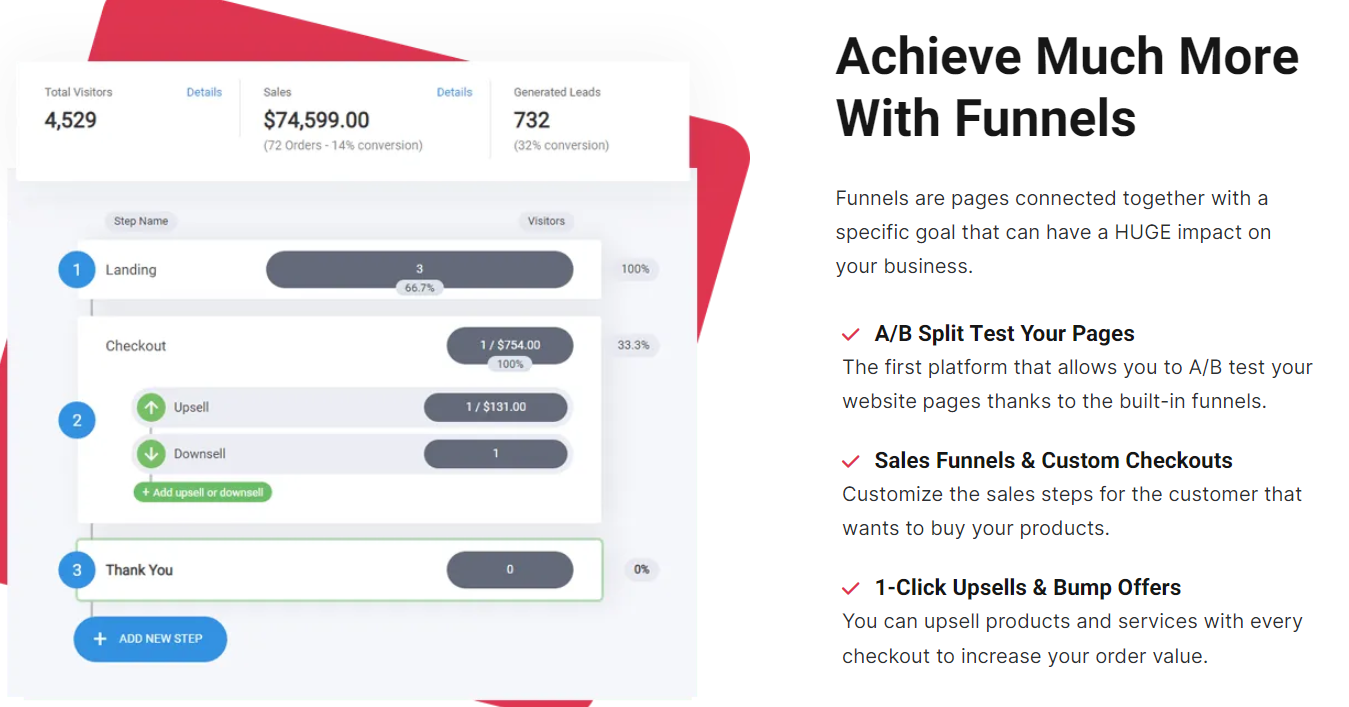
9. Simvoly: best for combining a small-business site and funnels
Simvoly advertises their Starter plan at $18 monthly or $12 per month annually, but Starter has no funnels. A fair ClickFunnels comparison begins with Business at $36 monthly or $29 annually, which includes five funnels. Premium is $49 monthly or $39 annually for ten funnels; Elite is $97 monthly or $79 annually with unlimited funnels. A 14-day trial is available.
Site, funnel, CRM, store, and commerce records can stay within one platform. Email allowances and add-ons vary, so total cost needs a campaign-volume check. This architecture suits a small team that wants one website and funnel environment without WordPress.
Usable-tier distinction is the main lesson here. Our final view reflects practical workflow architecture, not just published feature lists.
| Simvoly pros | Simvoly cons |
|---|---|
| Website, funnels, CRM, and commerce share a platform; relatively low usable funnel price | Lowest tier has no funnels; email limits and add-ons need separate review |
10. Builderall: best for budget teams willing to learn a broad suite
Builderall Core plan is $27 monthly or a $12.75 monthly equivalent annually, but Core excludes email and ecommerce. Essentials plan is the more realistic Builderall vs ClickFunnels comparison at $47 monthly or $35.25 annually. It includes 3,000 subscribers, 60,000 sends, and ecommerce. Higher tiers expand automation and capacity. A 30-day money-back guarantee is listed.
Builderall modules share campaign and lead data, while external integrations extend the stack. Breadth can deliver value, but it also creates a learning and governance job. Pricing may vary by promotion or region, so you should checkout their available pices before confirmation.
I would shortlist this platform when a budget team genuinely plans to use several modules. If email is the main requirement, affordable email alternatives may produce a simpler stack.
In a “ClickFunnels vs Builderall” decision, compare usable tiers and required modules before comparing headline prices.
| Builderall pros | Builderall cons |
|---|---|
| Broad tool coverage at Essentials; email and ecommerce in one suite; refund protection | Low Core headline omits core comparison features; broad suite adds learning; packaging can vary |
11. Systeme.io: best free all-in-one starting point
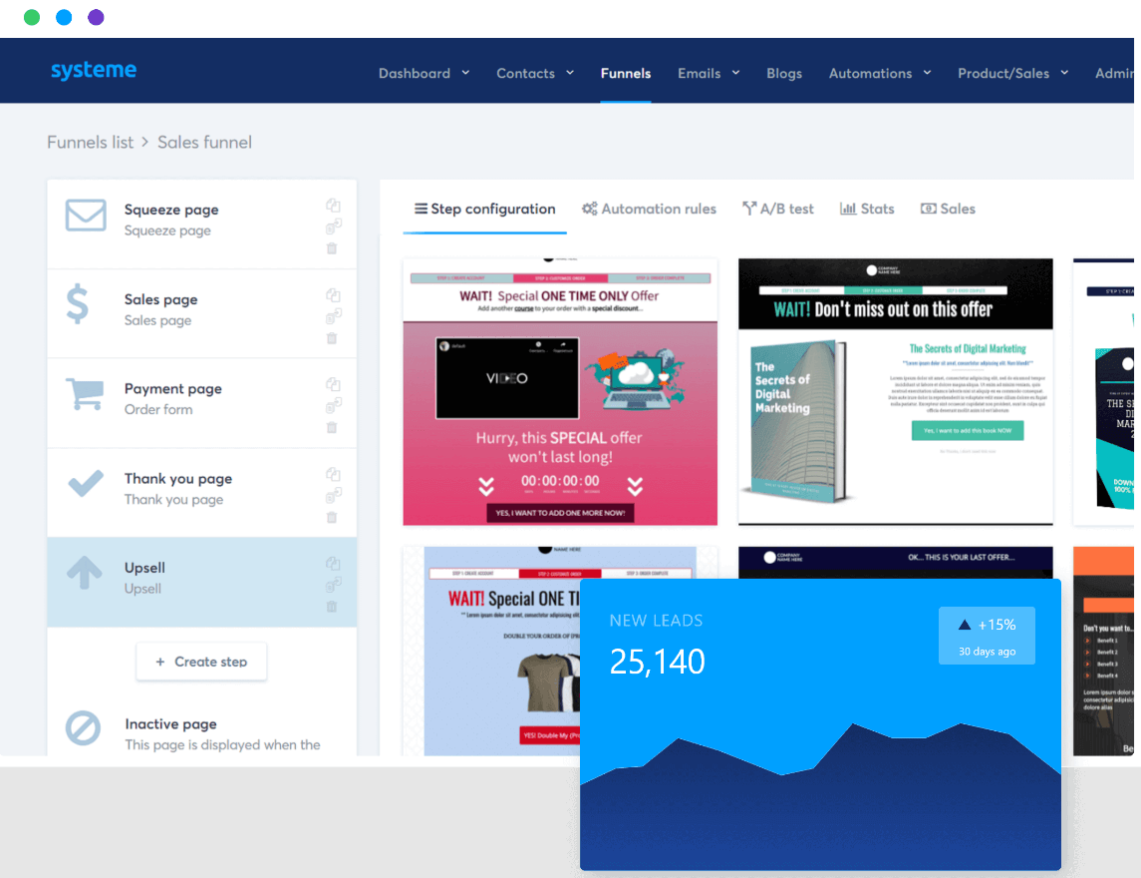
Systeme.io offers a free plan, Startup at $27 per month, Webinar at $47, and Unlimited at $97. We tried free access without a card, 2,000 contacts, a first funnel, unlimited email sending subject to plan rules, and no platform transaction fee. Payment processor fees still apply on paid plans purchase.
Funnels, pages, email, courses, affiliates, checkout, and automation share contact records. These features makes Systeme.io one of few free options with broad replacement intent. G2 reviewers often praise affordability and integration, while some report narrower design or reporting depth.
We became more confident in this recommendation after validating breadth and price together, but free limits still require a final live-plan check. Compare email economics with our ROI calculator rather than assuming free always means lowest operating cost.
| Systeme.io pros | Systeme.io cons |
|---|---|
| Free all-in-one entry; native email, funnels, checkout, courses, and affiliates | Free limits are not clear; specialist design/reporting depth may be lower |
ClickFunnels alternatives for WordPress
A ClickFunnels alternative for WordPress changes ownership and maintenance at the same time. Pages and checkout can remain on infrastructure your team controls, but updates, hosting, caching, security, and plugin compatibility become operational responsibilities. Explore our landing-page resources before deciding that ownership automatically means simplicity.
12. Thrive Suite: best broad WordPress conversion toolkit
Thrive Suite lists a promotional annual price of $299 and a $599 renewal, or $149 quarterly. It covers five self-hosted WordPress.org sites, eight plugins, and Theme Builder, with a 30-day money-back guarantee. Architect and Theme Builder handle pages, Leads captures contacts, Optimize supports tests, and Ultimatum adds scarcity.
Leads pass into connected email services, while payments need an external cart or integration. That modularity preserves WordPress control but adds several dependencies. Individual reviewers report both conversion-tool breadth and occasional plugin, update, or integration friction. These are user reports, not universal findings.
We would choose this tool when a WordPress team wants site and conversion control and already has email and payment systems.

| Thrive Suite pros | Thrive Suite cons |
|---|---|
| Broad WordPress conversion toolkit; testing and scarcity included; five-site allowance | Promotional price renews higher; plugin maintenance; external email and checkout required |
13. CartFlows: best for WooCommerce checkout funnels
CartFlows Starter plan is $99 per year and lists a $129 renewal for one site. It builds funnel steps and optimized checkout around WordPress and WooCommerce, including an order bump on the researched tier. Follow-up and customer messaging depend on WooCommerce data plus connected plugins or services.
This is a strong architecture match when product, payment, and order records already live in WooCommerce. It is less compelling for a team seeking hosted infrastructure or native email CRM.
Our recommendation changed after separating checkout ownership from email automation. CartFlows can replace a checkout funnel without replacing nurture. Use our ecommerce email comparison tool to choose that connected layer.
| CartFlows pros | CartFlows cons |
|---|---|
| Native WooCommerce workflow; low annual plugin cost; optimized checkout and order bump | Requires WordPress and WooCommerce; no native sender CRM; feature gates need recheck |
14. OptimizePress: best WordPress funnel suite at a clear annual price
OptimizePress Launch plan costs $129 yearly for one site and pages. Scale costs $199 yearly for five sites and adds Funnels, Checkouts, Urgency, Mentor, and Flow, plus Stripe and PayPal. It has 50 integrations and a 14-day money-back guarantee.
Scale plan is the usable comparison tier. Leads and payments move from WordPress into connected services, while the site retains its page and funnel layer. This works for marketers who want more than landing pages without moving to a hosted suite. External email remains part of the architecture.
After comparing all platforms, this is one of the clearer WordPress value propositions, provided the team accepts plugin administration.
| OptimizePress pros | OptimizePress cons |
|---|---|
| Scale bundles pages, funnels, checkout, urgency, and five sites; strong WordPress ownership fit | Launch lacks funnel suite; external email required; ongoing WordPress maintenance |
15. SeedProd: best when landing pages are enough
SeedProd Basic plan has a $39.50 introductory annual price and renews at $79. Plus plan is $99.50 introductory and renews at $199; it adds email integrations and Theme Builder. SeedProd creates WordPress landing pages and site templates, but it is not a native CRM, email sender, automation engine, or complete checkout funnel.
That narrow scope can be a benefit. A team with reliable email, CRM, and commerce tools may only need faster page production. A team replacing ClickFunnels end to end would need too many additional parts.
I would shortlist this platform when page creation is the only documented gap. Teams still selecting only email can compare newsletter features instead of overloading a page plugin.
| SeedProd pros | SeedProd cons |
|---|---|
| Low introductory page-builder price; native WordPress workflow; focused scope | Renewal is higher; integrations begin above Basic; no native funnel, email, CRM, or checkout stack |
Choose ownership deliberately
Compare WordPress control with hosted convenience, then document who owns updates, security, checkout testing, and recovery. Continue with our landing-page resources when page architecture is the main decision.
Specialist alternatives that replace one funnel layer
16. Deadline Funnel: best for evergreen and fixed scarcity
Deadline Funnel Start plan costs $49 monthly or a $39 monthly equivalent annually, with three campaigns and 1,000 leads. Create is $99, Accelerate $149, and Scale $199 monthly. A free trial and 30-day money-back guarantee is also listed.
The product synchronizes evergreen or fixed deadlines across email and web, then controls timers and redirects. It does not provide a native sender, CRM, page suite, or checkout. That makes it a conversion layer for a working stack, not an alternative to ClickFunnels by itself.
Our analysis became clearer once we treated specialist tools as complements. If scarcity is the only missing capability, replacing an entire platform would be unnecessary. If email is also unsettled, start with the email marketing feature comparison sheet.
| Deadline Funnel pros | Deadline Funnel cons |
|---|---|
| Focused deadline logic; email and web synchronization; works with existing pages | No native email, CRM, pages, or checkout; campaign and lead caps on Start |
17. SamCart: best for checkout and average-order-value workflows
SamCart Core plan is $79 monthly or $710 yearly. Pro is $199 monthly or $1,790 yearly and adds one-click upsells, order bumps, A/B testing, and affiliate tools. A seven-day trial is available. Products, checkouts, pages, and courses are unlimited under published plan descriptions.
SamCart sends purchase events into external email or CRM systems through its integration engine. It is a focused choice for teams improving checkout and average order value, not a native lead-nurture replacement. Most recognizable conversion features require Pro.
We would choose this tool when checkout is the bottleneck and the rest of the marketing stack is stable. If you are mapping purchase follow-up, then you can use our ecommerce email tools comparison tool.
| SamCart pros | SamCart cons |
|---|---|
| Checkout-first workflow; unlimited product/page allowances; Pro adds strong conversion tools | Key upsell/bump/testing features require Pro; no native email CRM |
Useful tools for building a defensible shortlist
Turn the shortlist into an email decision
Validate subscriber volume, automation needs, and budget with our email platform selection guide.
A 30-day migration and pilot plan
Do not start by rebuilding every funnel. Start by mapping one representative path: traffic source, page, form, consent record, automation, checkout, purchase event, and report. Export assets and contact fields before changing domains or tracking. Record which system owns unsubscribe status, attribution, product data, and revenue reporting.
During week one, compare fields and integrations. During week two, build one low-risk journey. During week three, test mobile layout, form errors, duplicate records, payment events, email delivery, and team permissions. During week four, compare results, document exceptions, and choose a rollback date. A transactional email API calculator can help when purchase or account messages sit outside the marketing sender.
Our final view reflects practical workflow architecture, not just published feature lists. The safest pilot preserves consent, attribution, and a rollback path. For a larger selection project, our platform selection and optimization service provides a structured next step.
Get structured selection support
If migration affects several teams or systems, use our platform selection and optimization service to document requirements and tradeoffs.
Conclusion: build a shortlist from cost, coverage, and control
After comparing all platforms, no single alternative wins every workflow. MailerLite, GetResponse, and Kit make sense when email owns the customer journey. Kartra, Kajabi, GoHighLevel, Keap, Builderall, Simvoly, and Systeme.io cover more layers. Thrive Suite, CartFlows, OptimizePress, and SeedProd favor WordPress control. Perspective, Deadline Funnel, and SamCart solve narrower problems.
So, your search for “ClickFunnels similar tools” often mix these categories, which is why architecture remains the cleaner first filter.
Annual usable cost versus native stack coverage
How to use: choose a budget band, then inspect missing layers. Free points may have restrictive caps. Annual equivalents do not include usage fees or migration.
Accessible graph data
| Tool | Annual equivalent | Native layers | Billing note |
|---|---|---|---|
| MailerLite | $0 | 3 of 5 | Free; paid Comfort from $12/mo |
| GetResponse | $228 | 4 of 5 | Monthly Starter; $15.58/mo equivalent annually |
| Kartra | $1,428 | 5 of 5 | Monthly Starter; $99/mo equivalent annually |
| Perspective | $0 | 1 of 5 | Free; Base $47/mo equivalent annually |
| Thrive Suite | $299 | 2 of 5 | Promotional annual price; $599 renewal; $149 quarterly |
| Deadline Funnel | $588 | 1 of 5 | Monthly Start; $39/mo equivalent annually |
| Kajabi | $2,148 | 4 of 5 | Monthly Basic; $143/mo equivalent annually |
| Simvoly | $432 | 5 of 5 | Monthly Starter; $12/mo equivalent annually |
| Kit | $0 | 3 of 5 | Free Newsletter; Creator $39/mo for 1,000 subscribers |
| Builderall | $564 | 4 of 5 | Monthly Core; $12.75/mo equivalent annually |
| SamCart | $948 | 2 of 5 | Monthly Core; $710/year |
| GoHighLevel | $1,164 | 5 of 5 | Monthly Starter |
| Keap | $3,588 | 5 of 5 | Billed $2,988/year |
| CartFlows | $99 | 2 of 5 | Annual Starter; $129 renewal |
| OptimizePress | $199 | 3 of 5 | Annual Launch; Scale $199/year |
| SeedProd | $40 | 1 of 5 | Intro annual Basic; renews at $79 |
| Systeme.io | $0 | 4 of 5 | Free; Startup $27/mo; Webinar $47; Unlimited $97 |
Ownership and control versus operating burden
How to use: choose an acceptable maintenance zone first, then compare tools within that zone. Confirm who owns updates, integrations, consent data, checkout testing, and recovery.
Accessible graph data
| Architecture | Control | Burden | Tools |
|---|---|---|---|
| WordPress-native | Higher infrastructure control | Higher maintenance | Thrive Suite, CartFlows, OptimizePress, SeedProd |
| Hosted all-in-one | Lower infrastructure control | Lower infrastructure work, higher platform concentration | Kartra, Kajabi, GoHighLevel, Keap, Builderall, Simvoly, Systeme.io |
| Email-first hosted | Moderate stack flexibility | Moderate integration work | MailerLite, GetResponse, Kit |
| Specialist hosted | Depends on retained stack | Adds another integration and owner | Perspective, Deadline Funnel, SamCart |
If I were managing a team today, I would keep three candidates: one that preserves the current stack, one that consolidates it, and one low-cost pilot. Then I would run the same representative funnel through each. Use our email platform selection guide and ROI calculator to challenge the financial assumptions.
Frequently asked questions
What is the best free ClickFunnels alternative for a marketing team?
MailerLite fits simple email capture, Kit fits creator newsletters, Perspective fits a tiny mobile lead-funnel test, and Systeme.io offers the broadest free all-in-one intent. “Best” depends on required native layers and free-plan caps.
Which ClickFunnels alternative works with WordPress?
Thrive Suite, CartFlows, OptimizePress, and SeedProd are WordPress-native. CartFlows specifically depends on WooCommerce. Hosted tools can link, embed, or integrate, but they do not provide the same infrastructure control.
Is GetResponse or ClickFunnels better for email automation?
GetResponse is email-first, with advanced automation beginning on Marketer. ClickFunnels is broader funnel software. Read the full GetResponse vs ClickFunnels comparison when email depth is the deciding factor.
Are Builderall and Systeme.io genuinely cheaper after usable-plan limits?
They can be. Builderall Essentials is the relevant email-and-ecommerce tier at $47 monthly, not Core. Systeme.io has a free plan and $27 Startup tier, but free limits need a final live check. Compare required modules and usage, not only starting price.
Which alternative includes CRM and team workflows?
GoHighLevel, Keap, Kartra, Simvoly, Kajabi, Builderall, and Systeme.io keep multiple workflow layers together, with different CRM depth. GoHighLevel emphasizes agencies and subaccounts; Keap emphasizes CRM-led follow-up.
How should a team migrate without losing tracking or consent records?
Map one journey, export assets and fields, identify the owner of consent and attribution, test duplicate handling and purchase events, then preserve a rollback window. Migrate the representative path before rebuilding every funnel.
No updates recorded yet.
How do we evaluate email marketing tool?
Manual testing is the process that goes beyond just ticking boxes. Our team start by defining clear testing objectives based on the intended use of email marketing tools and platforms. Each tools undergoes a rigorous user experience analysis, where we simulate real-world scenarios to gauge performance, usability, and reliability.
We pay special attention to the integration capabilities, data security, and compliance standards of the MarTech vendor. This hands-on 25 test-point approach allows us to uncover nuances that automated testing might miss, providing a more holistic understanding of the tools.
How do we evaluate and benchmark email marketing service effectively?
Our evaluation process is data-driven and multi-dimensional. Our team analyze tool performance metrics against industry standards and similar product platforms.
Key performance indicators (KPIs) are meticulously examined, including ease of use, customization options, scalability, customer support effectiveness, and innovation. We also incorporate user feedback to ensure our benchmarks reflect actual user experiences and expectations.
This comprehensive method ensures a fair and effective comparison of the email marketing services.
How accurate are these comparisons and alternative suggestions of the email marketing tools?
We pride ourselves on the accuracy of our comparisons and suggestions. Our team expertise, combined with advanced analytics tools, ensures that our data is both current and relevant. We constantly update our database with the latest market trends and user feedback, which helps us provide accurate and timely recommendations.
However, it’s important to remember that each business has unique needs, and our suggestions are a starting point for their decision-making process.
Why email marketing tool buyers trust Sprout24 reports and analysis?
Our reputation for trustworthiness stems from our commitment to impartiality and depth of research. We do not just skim the surface; we go deep into each email marketing tools and service capabilities and shortcomings.
Our reports are comprehensive, easy to understand, and transparent, explaining not just what we recommend but why. This transparency and thoroughness are why email marketing tool buyers trust our reports.
Our FTC Disclosure explains the sources of funding and revenue of Sprout24 platform; this enables us to curate straightforward and unbiased reviews.
How these reports help in reducing the time to purchase a email marketing platform?
Our reports and guides significantly reduce the time to purchase by providing clear, concise, and comparative information. Email marketing tool buyers don’t have to spend countless hours researching; they can find all the necessary information in one place.
Our Sprout scoring system, user reviews, and feature comparisons simplify the decision-making process, enabling buyers to make informed choices quickly.
How effective is the scoring system and help email marketing service buyers in making fast decision?
Sprout Score Scale of 0–10 rating is crafted to provide a quick, yet detailed view of a platform overall standing in various categories.
This scoring system, backed by in-depth contextual data analysis, allows email marketing service buyers to immediately gauge suitability of the tool / service for their needs. It simplifies complexity and enables fast, informed decisions, which is crucial in the fast-paced world of business.


