
 Connor Reynolds

I have learned to pay close attention to Google Trends as an early indicator of where the market is heading. Search behavior often tells us what people are curious about long before we see adoption at scale. Over the past few months, one signal that stood out to me: the rapid rise in global search interest for workflow automation.
For years, workflow automation was treated as a quiet back-office function, more of an IT initiative than a marketing or growth priority. But the latest data paints a different picture. In mid-2025, searches for “workflow automation” surged dramatically, reaching their highest point in the last five years. This isn’t just noise, it’s a shift that could redefine how businesses scale their operations, marketing, and customer engagement.
Google Trends Data: The Spike in Workflow Automation
Looking at Google Trends data from the past five years, the pattern is clear. From 2020 through early 2025, search interest in workflow automation stayed fairly flat, with only minor spikes. Then, almost overnight, interest surged to record-breaking levels.
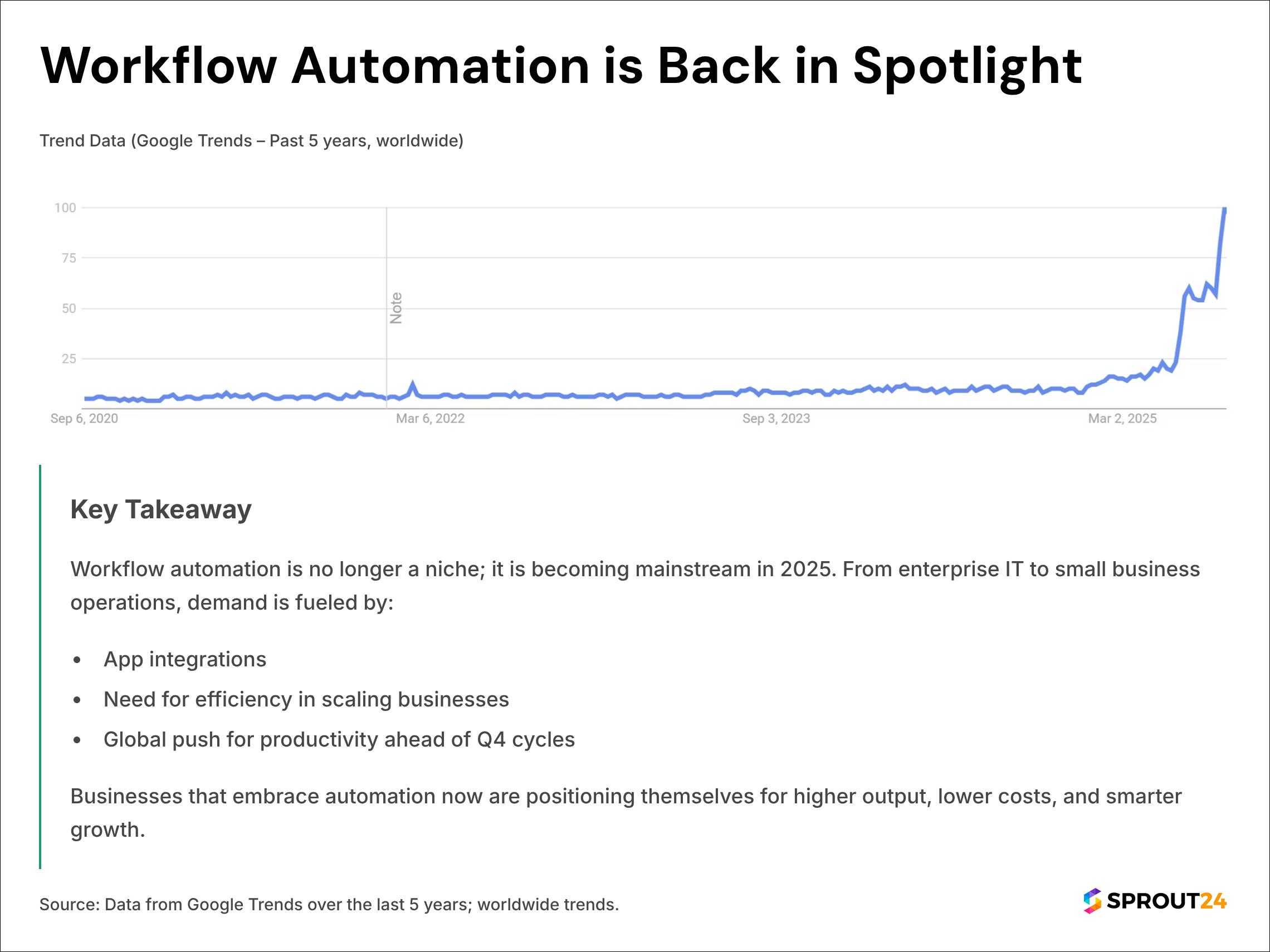
Workflow Automation (blue): Consistently higher interest. Noticeable surge in August-2025 with a sharp upward trend.
What is notable is the timing. Th is spike aligns with a broader market push toward AI-powered productivity tools and a renewed focus on operational efficiency as businesses prepare for Q4 cycles. This isn’t a one-off blip, it is part of a larger wave where companies are aggressively seeking ways to do more with less, and automation is stepping out of the shadows into the spotlight.
Regional Insights: Who are Searching?
Regional data is equally revealing. Surprisingly, the small island territory of St. Helena tops the chart, followed closely by the United States, United Arab Emirates, Singapore, and Nigeria.
The U.S. makes sense, it’s the hub of SaaS, enterprise IT, and MarTech innovation. UAE and Singapore are particularly interesting, as both regions are doubling down on digital transformation initiatives, with governments actively incentivizing automation and AI adoption. Appearance of Nigeria in the top five signals the growing role of emerging markets, where automation is seen as a leapfrog opportunity to bypass inefficiencies and accelerate business scalability.
This mix of developed and emerging markets suggests that workflow automation is not confined to enterprise-heavy economies anymore. Instead, it’s becoming a global necessity, adopted by startups, SMBs, and corporates alike.
Related Queries & Topics: Where the Buzz Is
When I dug deeper into the related queries, the picture became even more compelling. The most significant breakout is around NetApp OnCommand Workflow Automation, which shows that enterprise IT teams are actively exploring large-scale automation frameworks. On the other hand, tools like n8n, an open-source workflow automation platform, are also climbing fast in the queries list.
This duality is fascinating. It tells me that both enterprise-level solutions and lightweight, open-source tools are gaining traction at the same time. Businesses of all sizes are looking for automation, whether through enterprise-grade infrastructure or more flexible, cost-effective alternatives.
Another interesting layer is the rise of queries linking workflow automation with broader contexts like cryptocurrency and “2024/2025 topics.” This shows the expanding relevance of automation across industries far beyond traditional IT or marketing stacks.
Key Drivers Behind the Trend
So, what is fueling this sudden global surge? I see four major drivers:
- AI Integration: Just as we covered in our Cold Email is Back in the Spotlight post (read here), AI is reshaping every channel. Now it is powering workflow automation, enabling businesses to create intelligent, adaptive processes instead of rigid rules.
- Scalability & Efficiency Pressures: With tighter budgets and growing expectations, companies need ways to scale without ballooning headcount. Workflow automation fills that gap.
- Community Buzz & Peer Adoption: Much like we saw with the resurgence of Blog vs. Newsletter searches (analysis here), conversations within professional communities are sparking curiosity. When peers share success stories, searches spike.
- Seasonal Q4 Momentum: Just as with cold email, the August/September spike reflects businesses gearing up for Q4, a time when operational efficiency becomes mission-critical.
Why This Matters for B2B Businesses?
For B2B companies, workflow automation is no longer a back-office optimization. It is quickly becoming a frontline growth enabler. Here is why:
- Sales teams can route leads instantly, cutting response times.
- Marketing teams can build more sophisticated, multi-channel customer journeys.
- Customer success teams can automate onboarding and support workflows.
In essence, workflow automation is the connective tissue that holds modern B2B stacks together. Without it, businesses risk bottlenecks, delays, and missed opportunities.
Actionable Takeaways for Businesses
If you are considering workflow automation, here is where I suggest starting:
- Audit your current workflows: Identify repetitive, manual tasks slowing your team down.
- Experiment with lightweight tools: Platforms like Zapier, Make, or n8n allow you to test automation without heavy upfront costs.
- Plan for scale: If you are a larger business, look at enterprise-grade solutions that integrate deeply with your Email Tools, CRM, ERP, and marketing automation platforms.
- Pair automation with human oversight: Automate repetitive tasks, but keep humans in the loop for judgment-driven decisions.
Final Thoughts
This surge in workflow automation searches isn’t just a passing blip. It reflects a deeper shift in how businesses are preparing for the future. Just as cold email evolved into a smarter, more personalized channel, and blogs found new life alongside newsletters, workflow automation is stepping into the spotlight as a growth multiplier.
At Sprout24, we have been tracking these shifts closely because they reveal how marketing and operations are converging. My takeaway for B2B leaders is simple:
- Use blogs to be discovered.
- Use newsletters to nurture.
- Use cold email to directly engage.
- And now, use workflow automation to scale it all efficiently.
Those who adopt early will not only save time and money but also position themselves as more agile, data-driven, and competitive going into 2026.


