
 Connor Reynolds

If you have been following Google Trends lately, you might have noticed something surprising: search interest in “cold email” spiked sharply in August 2025. For nearly a year, interest remained relatively steady at low levels, but then, almost overnight, searches climbed to their highest point in months.
Google Trends: Cold Email
Looking at relative search interest (Google Trends, worldwide, past 5 years), we see a distinct shift in market attention:
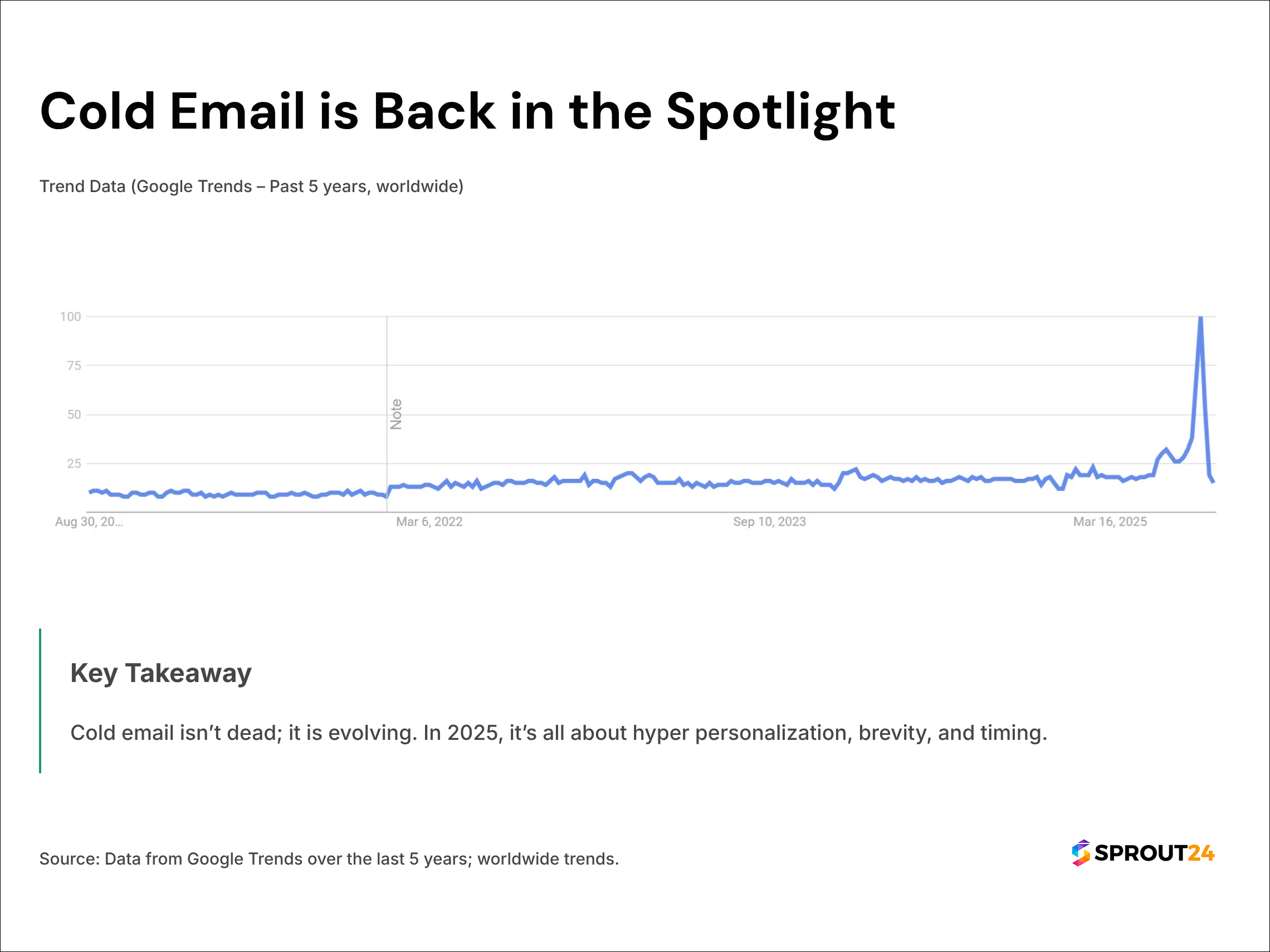
Cold Email (blue): Consistently higher interest. Noticeable surge in August-2025 with a sharp upward trend.
So, what is driving this sudden surge? Is it a shift in marketing strategies, a new wave of technology, or something else entirely?
Let’s unpack the story behind the spike and what it means for marketers going forward.
Key Drivers:
- Seasonal Push – Businesses ramp up outreach before Q4.
- AI Tools – New playbooks & comparisons fuel curiosity.
- Fresh Data – Updated stats show reply rates up to 40–50%.
- Evolved Approach – Short, personal, human emails outperform templates.
- Community Buzz – Marketers share success stories, sparking wider interest.
Seasonal Marketing Momentum: The Pre-Q4 Push
The first explanation lies in timing. August sits at the end of summer, a transitional period when businesses gear up for the final quarter of the year. For B2B and SaaS companies in particular, Q4 is a critical time to close deals, renew contracts, and hit revenue targets.
That urgency often sparks a wave of outbound activity. Cold email remains one of the most scalable and cost-effective methods to re-engage leads, nurture prospects, and expand sales pipelines. It is no surprise that as August rolled around, businesses worldwide began refreshing their cold email playbooks.
AI Factor: New Tools, Playbooks, and Comparisons
Another major driver is technology, specifically AI. August 2025 saw a flood of new resources and comparisons between AI-powered outreach tools. Platforms like Instantly and Apollo published fresh playbooks, benchmarks, and side-by-side tool reviews, showcasing how AI can optimize everything from subject line testing to personalization at scale.
For marketers under pressure to do more with less, these tools offer a compelling promise: automate the heavy lifting while keeping outreach personal. The timing of these launches and updates no doubt contributed to the spike in searches.
Fresh Data Creates Buzz
Data drives decisions, and August brought a wave of updated cold email statistics from industry leaders. Blogs highlighted that while the average cold email response rate hovers around 8 to 9%, top campaigns achieve reply rates above 40%.
These statistics are not just numbers, they create a sense of possibility. Marketers who may have written off cold email as outdated suddenly saw proof that, when done right, it still delivers. That alone is enough to reignite interest.
Evolution of Cold Email
Cold email has been declared “dead” countless times, yet it keeps evolving instead of disappearing. The difference in 2025 is clear: successful cold email is shorter, more human, and highly personalized.
Gone are the days of mass-blast templates filled with jargon. Instead, today’s winning campaigns look like genuine conversations, crafted to solve a problem for prospect, not sell them immediately. Communities on Reddit and LinkedIn are buzzing with reminders that “cold email isn’t dead; bad cold email is.”
This shift in best practices is another reason marketers are seeking updated guidance, fueling the spike in search interest.
Community and Peer Influence
Finally, there is word-of-mouth factor too. As thought leaders, agencies, and communities share case studies of cold email success, others take notice. Peer conversations spark curiosity, which in turn drives search interest. In August 2025, that chatter reached a tipping point.
What This Means for Marketers?
Surge in August 2025 is more than just a blip. It signals that cold email is experiencing a renewed wave of relevance, fueled by seasonal urgency, AI tools for sales, fresh data, and an evolved approach to outreach.
For marketers, this means two things:
- Cold email is not going away. It is still one of the most powerful, measurable, and cost-efficient channels, especially for B2B.
- The rules have changed. The days of long, impersonal, spray-and-pray emails are over. Modern cold email demands personalization, brevity, and strategic follow-up.
Final Thoughts
This spike in searches for “cold email” in August 2025 isn’t just about curiosity, it is about confidence. Marketers are recognizing that cold email, when adapted to today’s expectations, remains a cornerstone of modern outreach.
But cold email isn’t the only channel seeing renewed attention. Recent Google Trends data revealed that blogs are experiencing a renewed surge in global searches in August 2025 too, outpacing newsletters significantly. While blogs remain powerful for visibility and SEO-driven discovery, newsletters continue to serve as a reliable channel for nurturing relationships.
That is why this infographic is so important, it not only highlights the story behind the cold email spike, but also sheds light on broader content marketing trends. For businesses shaping their strategies, the takeaway is clear:
- Use blogs to be discovered and build authority.
- Use newsletters to deepen trust and engagement.
- Use cold email to create direct, personalized opportunities.
Together, these channels form a balanced, modern marketing mix.


